
Being direct. Setting high standards. Knowing how things should be done. These can all help us lead. But how do we recognise when the qualities we rely on begin to hold other people back?
For Janet Motah, that question became clearer during her Women Emerging Expedition. She began to notice how her bluntness and perfectionism could make people hesitate before approaching her, or leave too little room for someone still learning.
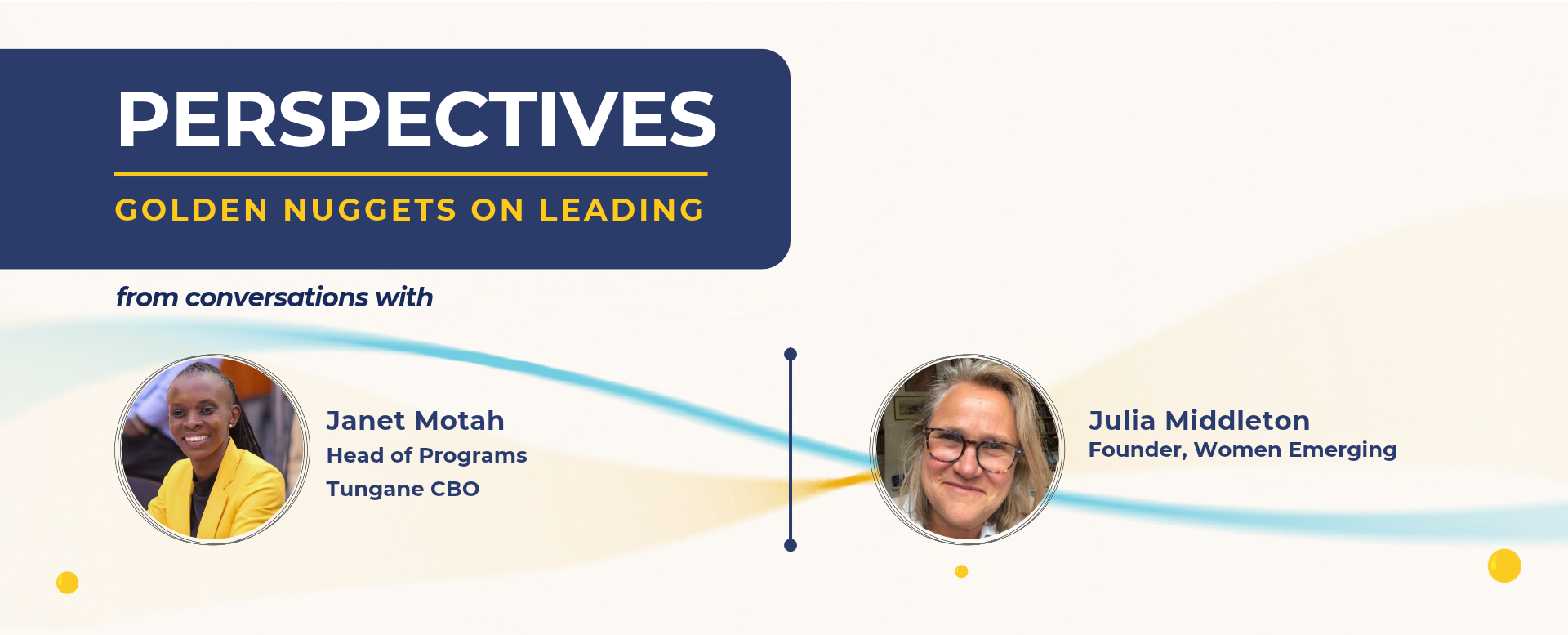
Janet is a sport for development practitioner and mentor whose work includes supporting women in sport. In this conversation with Julia, she reflects on how looking closely at her own habits changed her understanding of what others needed from her.
A strength can also become a barrier
During her Expedition, Janet took part in a mask exercise. On one side, she illustrated the kind of leading she wanted to do. On the other, she explored what was holding her back.
The exercise brought her face to face with qualities she had considered strengths. She valued being straightforward, but began to recognise that people might avoid asking for help because they were unsure how she would respond. Her desire to get things right could also overlook someone else’s stage of development.
“I used to think that so many things are common sense,” she says.
What seemed obvious to Janet was not necessarily obvious to someone with different experience. Recognising that meant reconsidering her expectations and giving people more space to learn.
What worked before may need to change
“We need to unlearn and we need to relearn.”
Janet’s reflection reaches beyond perfectionism. She describes how different generations can approach work differently, including their willingness to use tools such as AI. Someone taught to work everything out without assistance might struggle to accept another person’s approach.
Insisting on familiar methods can make it harder to recognise what others bring. It can also create distance between the person leading and the people doing the work.
For Janet, unlearning involves questioning those inherited expectations. Are they helping people do good work now? Or are they being carried forward because they once made sense?
Having every answer can limit other people’s growth
That same questioning extends to the expectation that those leading should always know what to do.
Janet describes the difficulty of having a team place so much confidence in her that her answer becomes final. If everyone turns to her for every decision, when do they develop their own judgement?
Julia points out that there will be times when Janet is absent, or when her answer is wrong. People need opportunities to think and decide for themselves.
Janet has begun making room for that. Sometimes she holds back an answer she already has, encouraging others to work towards a solution. It asks something of her, too: the willingness to let them try without controlling every step.
Confidence grows when people have opportunities to lead
In a network for young mothers, Janet put this into practice. She led the first meeting, then invited others to chair, moderate and take minutes at subsequent meetings.
Afterwards, she acknowledged their efforts and discussed areas for improvement. Some told her that the experience had given them confidence to chair more meetings and take on responsibilities in their communities.
“Sometimes the team just need someone who believes in them,” she says.
Towards the end of the conversation, Julia notices that Janet no longer sounds like the perfectionist she described at the beginning. Janet acknowledges that she has worked hard on it.
The change is visible in what she now makes possible for others: room to ask, room to practise and room to lead. Her experience invites us to examine our own familiar habits. Which still serve us, and which might be limiting what happens next?
Listen to Janet Motah’s full conversation with Julia on the WE Hub, and consider what you might need to unlearn to lead differently.