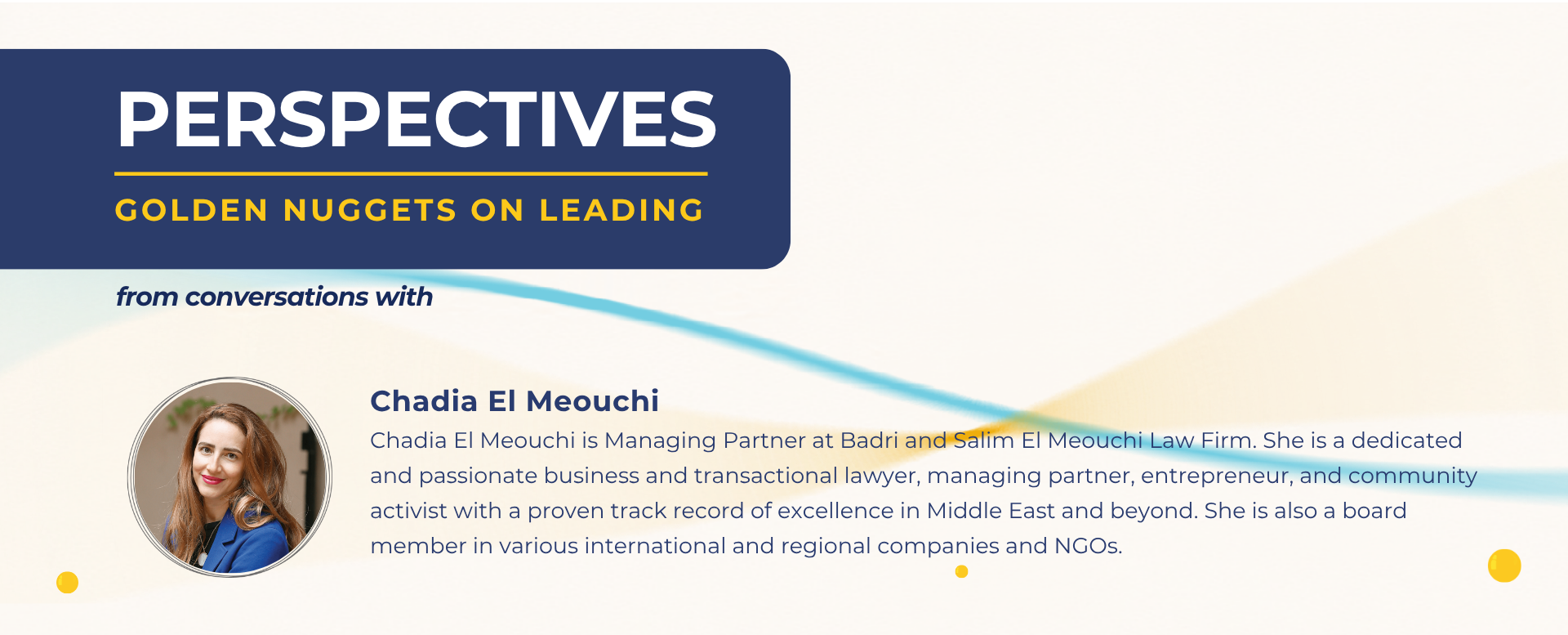
When we think about what shapes the way we work with others, we often point to education, mentors, career experiences or personality. Trauma rarely makes the list. It belongs, we assume, to another part of life—something deeply personal, something to survive rather than something that might quietly influence how we make decisions, build trust or respond to uncertainty. Yet this conversation with Chadia El Meouchi, lawyer, peacebuilder and social entrepreneur based in Lebanon, invites Julia Middleton to consider exactly that. Rather than viewing trauma solely as something to overcome, they explore how our most difficult experiences can become part of the lens through which we understand people, navigate complexity and choose to show up every day.
The Experiences We Carry Never Really Leave Us
When Julia asks Chadia which part of her “Essence” has most influenced the way she works with others, the answer comes immediately. “I jumped onto trauma,” Chadia says, “because it really informs everything that I have gone through.” She isn’t referring to one defining moment but to a childhood shaped by the Lebanese civil war, by instability and by separation from her family when she was sent to boarding school in England without speaking English. Looking back, she describes those years matter-of-factly. “You’re used to a very unsafe and shaky ground under your feet,” she explains. “Which means that you’re always alert in everything that you do and you’re always adaptive.” It is a striking reflection because she never presents trauma as something that defines her identity. Instead, she shows how it has shaped the way she approaches uncertainty, relationships and change.
When Uncertainty Becomes Your Greatest Teacher
Listening to Chadia, Julia recognises that this is not simply a story about resilience. It is about perspective. Growing up in an environment where certainty could disappear overnight changes the way you think about planning. “I have vision, I have dreams,” Chadia tells her, “But I live and I lead on the day, on the month, because I know that at any time, something can change.” For many organisations, leadership is often associated with long-term strategy and carefully laid plans. Chadia doesn’t reject those ideas, but she reminds us that they only work when we are prepared for reality to interrupt them. “At any time,” she says, “I’m going to adapt and get on my feet and immediately think differently.”
That ability to adapt has been tested repeatedly. Reflecting on the past few years in Lebanon, Chadia lists one crisis after another: economic collapse, political revolution, the pandemic, the Beirut port explosion, power shortages and the loss of colleagues who left the country. “If you’re not adaptable,” she says simply, “you might be an amazing person, but you’re not going to survive in this kind of environment.” Her point isn’t that every workplace resembles Lebanon’s circumstances. Rather, it is that uncertainty is part of life, and our ability to respond thoughtfully often matters more than our ability to predict what comes next.
Choosing Curiosity Over Judgement
Perhaps the most unexpected part of this conversation with Chadia El Meouchi is that these experiences have not left her distrustful of people. Quite the opposite. “I fundamentally believe that everybody has good in them somehow,” she tells Julia, “andwants to make a positive impact in the world.” It is a remarkably hopeful statement from someone who has witnessed conflict so closely. Yet she quickly acknowledges that life can take people in different directions. “You get lost along the way,” she says, “and this is why I have a lot of tolerance and forgiveness for people who get lost and for people who lose their way.” Rather than judging people by the position they currently occupy, Chadia has learned to become curious about the journey that brought them there.
Julia is fascinated by what this looks like in practice. How do you continue believing in people when they hold views completely different from your own? Chadia’s answer begins with something deceptively simple: “Put yourself in the other person’s shoes.” But she quickly adds that empathy requires more than imagination. “The first thing that you need to do is actually learn about the other person,” she explains. “Connect with somebody who you actually feel anger or hate or all these negative thoughts towards… and understand where it’s coming from.” For her, curiosity is not about agreeing with everyone. It is about refusing to reduce people to a single opinion or action.
The Courage to Stay in Difficult Conversations
That willingness to remain curious has transformed many of Chadia’s own conversations. “If you do it with vulnerability,” she reflects, “somebody’s story becomes your own.” She describes meeting people whose beliefs differed radically from hers and choosing not to walk away. Instead, she listened. “I’ve heard so many people who I completely disagreed with,” she says. “Then I would listen to where this is coming from… We would actually have a really deep discussion about my pain, about their pain.” The disagreement did not necessarily disappear, but something else emerged in its place: understanding.
There is an important lesson here. We often think difficult conversations require us to persuade someone else. Chadia suggests something different. Before trying to change another person’s mind, we might first try to understand the experiences that shaped it.
The One Line She Refuses to Draw
Towards the end of this conversation with Chadia El Meouchi, Julia asks perhaps the hardest question of all. Surely there comes a point where you stop trying. Surely there are people or situations where you have to draw the line.
Chadia pauses before answering. In her legal work, there are practical boundaries that must be respected. But when it comes to peacebuilding, her answer is unequivocal. “If it’s for peacebuilding,” she says, “I don’t think you ever draw the line.” She knows this work is slow. “It’s one of the seeds that you’re planting,” she reflects. “Someone else might reap it somewhere down the line.” Then she smiles and adds the line that perhaps captures her philosophy better than any other: “I’ve been told to draw the line many times. But I will not draw the line when it comes to that. This is my red line.”
The Stories Behind the People We Meet
By the end of this conversation with Chadia El Meouchi, it becomes clear that the subject is not trauma alone. It is about recognising that every person carries experiences that quietly shape how they see the world. Some experiences make us cautious, others make us resilient, others deepen our compassion. The challenge is not to ignore those stories but to become curious about them—both in ourselves and in the people around us.
Perhaps that is the lasting insight from this conversation. Before we judge how someone behaves, it is worth asking what they have lived through. We rarely see the experiences that shape another person, but they are often the very things that determinehow they respond, whom they trust and how they choose to work with others. Sometimes, understanding begins not with finding the right answer, but with asking a better question.