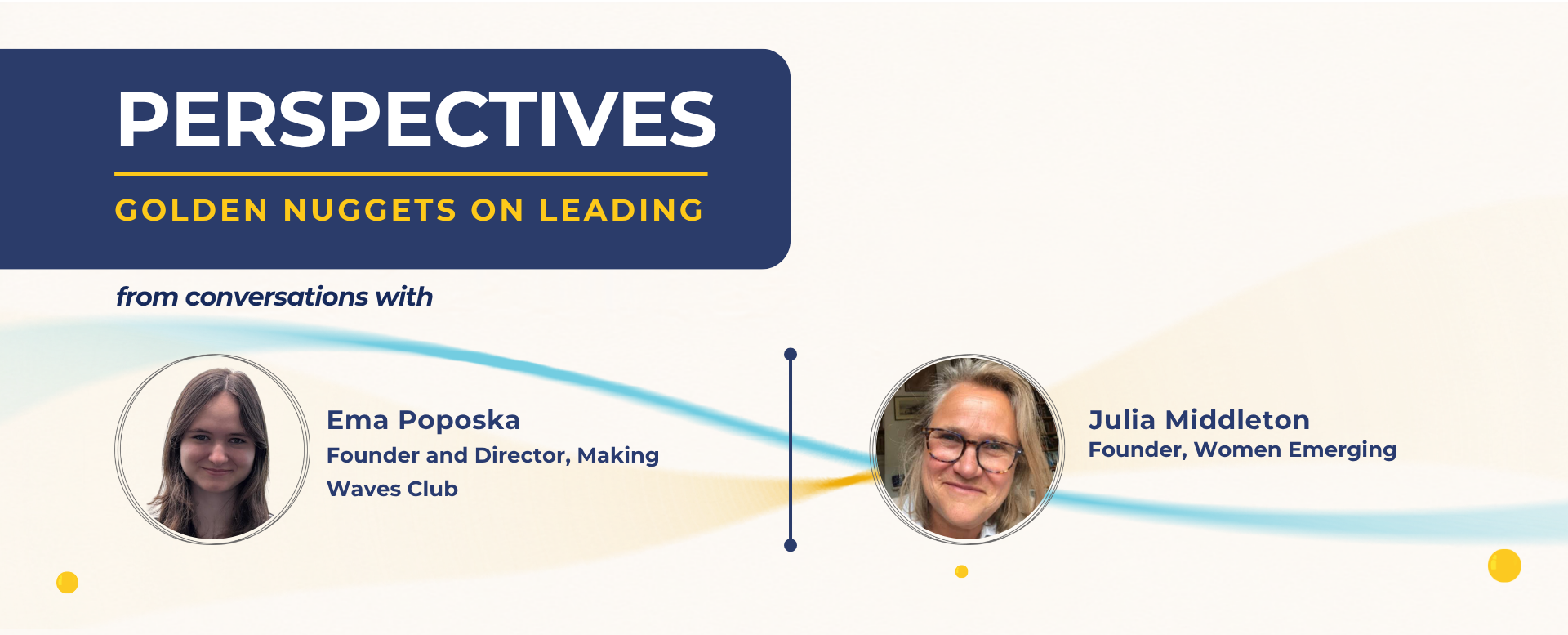
What if you could go back to the moment you first began leading and tell yourself what you know now? For Ema, that would mean going back to the age of 12. Although, as Julia discovers in their conversation, perhaps even 12 is too late. In the playground, Ema was already organising her friends according to their imaginary superpowers. Hers, naturally, was water. Water would stay with her.
Ema grew up in Hong Kong, close to the ocean, sailing, surfing, diving and listening to the waves. She got her scuba diving licence at ten, and what she saw beneath the surface made her want to bring other people with her. At 12, she created The Living Sea, a documentary using her underwater footage to show people a world they might otherwise never see, and why protecting it matters. Creating the film meant bringing together friends, volunteers, organisations and supporters. Suddenly, Ema was not simply a young person with an idea. She was asking people, many of them much older than her, to believe in it too. Looking back over the decade since, Julia asks her a simple question: what would you tell that 12-year-old now?
You don’t have to become older to be taken seriously
For a long time, Ema thought leading belonged to people with more experience. People who had done it before. People who were older. Working with adults could therefore be intimidating. She sometimes worried that being young made her appear less committed or less capable, and found herself trying to act older in order to be respected. But eventually she realised that pretending to be someone else was not what brought people towards her.
“I really just stuck to my passion,” she tells Julia. When people could see how deeply committed she was to the ocean and to inspiring others, they wanted to become part of what she was creating.
There is something interesting here about what we confuse with maturity. Seriousness can look like maturity. So can restraint. Fun, curiosity and imagination, meanwhile, are often dismissed as childish. Julia questions whether these distinctions are useful at all.
Perhaps the challenge is not to become less childlike as we grow into leading, but to recognise what being childlike can give us: creativity, freedom, curiosity and the courage to imagine things differently.
Ema found that when she stopped trying to appear older and instead brought her own creativity and energy to what she was doing, she could lead from somewhere much more authentic.
And perhaps this is also why cross-generational collaboration matters. Different ages bring different experiences, knowledge and ways of seeing. The task is not to decide whose experience matters most, but to create enough space for all of it to contribute towards a shared purpose.
Learn from the ocean
If Ema could speak to her 12-year-old self, she would also tell her to keep listening to the ocean.
Whenever she feels stressed or overwhelmed, she returns to it. Sometimes by sailing or diving, sometimes simply by sitting beside the waves. It gives her somewhere to become quiet enough to think again.
But the ocean has taught her something more specific about leading.
“The ocean has shown me how to be calm through storms and also how to battle storms.”
When sailing, you cannot decide whether the wind will come. You can decide what you do with the sail. You can take in more wind, let some go, change direction or loosen the sail when you need to slow down.
Julia recognises the parallel immediately. The winds will come, whatever happens. What you can work with is your response to them.
There is another lesson beneath the surface too.
From above, we see only a fraction of what exists in the ocean. Dive underneath and another world appears. Ema has come to think about people in much the same way. What somebody carries within them is not always visible at first glance. There may be passion, ability and possibility that has not yet had the space or confidence to emerge.
Part of leading, then, can be noticing what is beneath the surface and helping it grow.
You may have to move beyond the version of yourself you know
Ema describes herself as naturally quiet and introverted. At 12, people were already telling her to speak up more.
She has not simply stopped being an introvert. Instead, she has learnt that leading sometimes asks her to move beyond what feels most comfortable. If she wants to find people who care about the same things, she has to meet them. She has to ask questions, make connections, understand what they can bring and what she can offer them.
Theatre became an unexpected part of learning how.
On stage and in theatre classes, Ema could try different roles, move differently, make a fool of herself and experiment without needing to know exactly who she was supposed to be. It helped her discover that being introverted and being able to step forward socially do not have to cancel each other out.
She can reach out, speak publicly and make connections, and still need solitude to think and reflect.
Perhaps leading does not always require us to replace one version of ourselves with another. Sometimes it asks us to discover that we contain more possibilities than we thought.
Don’t wait until you feel ready
The final thing Ema would tell her younger self is perhaps the simplest.
Start.
“The timing will never be right. You will never be perfect. You will never be enough. But just there’s no point in waiting. Just throw yourself into it.”
At 12, even calling herself a leader could feel intimidating. The title seemed to come with expectations she was not sure she could meet. Looking back, she wishes she had worried less about the label and concentrated more on doing the thing she cared about.
Because the learning came after she began.
She learnt about herself. She learnt about other people. She found allies. She developed new skills. And, through doing, she gradually discovered how she herself leads.
Julia ends by asking Ema to choose one word for the journey so far. Has leading been hard? Miserable? Inspiring?
Ema chooses fun.
Not because it has been without frustration or challenge, but because it has allowed her to keep learning, meet people she might never otherwise have met, try things she never imagined doing and continue discovering more about herself.
There is something wonderfully uncomplicated about that answer.
We can spend so much time wondering whether we are experienced enough, mature enough, confident enough or ready enough to lead that we forget that leading is also something we learn by doing.
Perhaps we do not need to arrive fully formed.
Perhaps, like Ema at 12, we begin with something we care about deeply, invite other people into it, and learn how to navigate the winds as they come.
Listen to Julia’s full conversation with Ema on the Women Emerging Podcast.