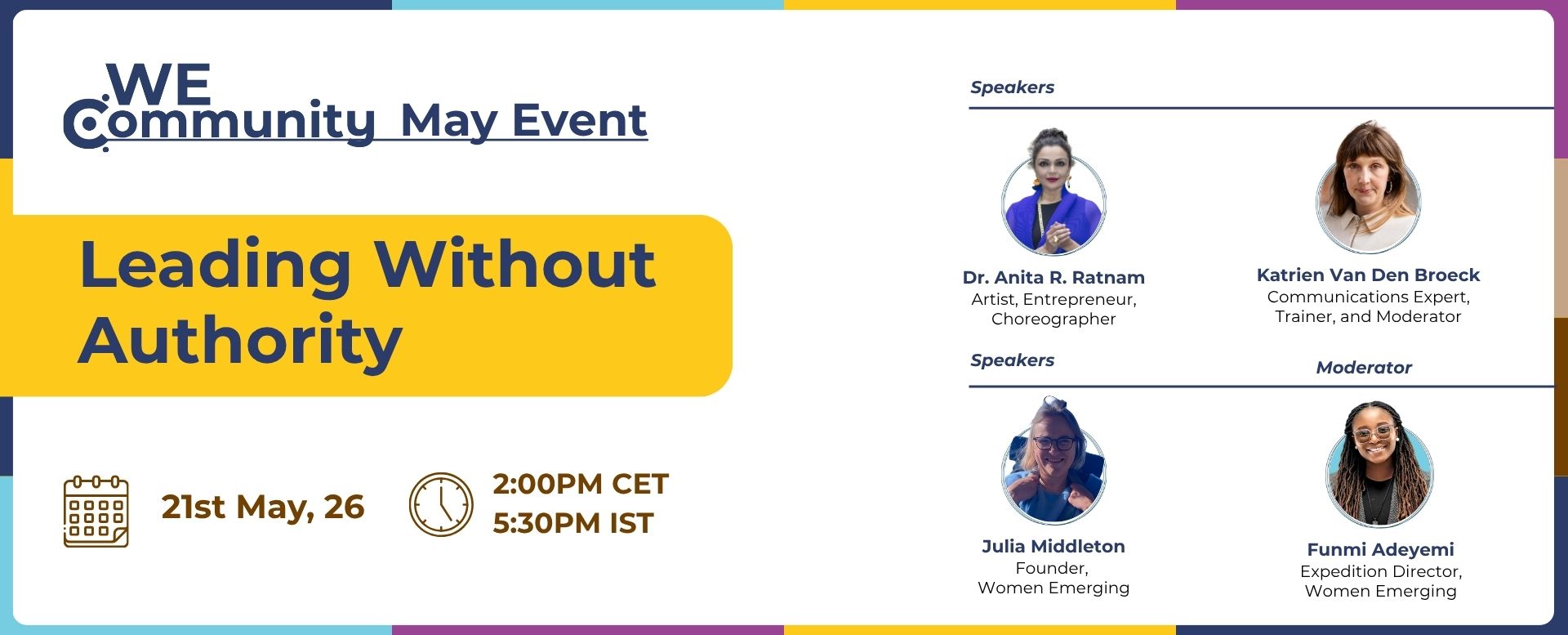
On 21st May 2026, the Women Emerging community came together for its May Community Event, centred on a theme: Leading Without Authority.
The conversation featured Dr. Anita R. Ratnam, Artist, Entrepreneur, and Choreographer; Katrien Van Den Broeck, Communications Expert, Trainer, and Moderator; and Julia Middleton, Founder, Women Emerging, and was moderated by Funmi Adeyemi, Expedition Director, Women Emerging.
The session reflected on the experience of leading without formal authority, where trust, credibility, and consistency matter more than hierarchy.
Rather than describing leading without authority as powerless, the conversation revealed it as another way of exercising power. Quietly. Relationally. Through trust, credibility, consistency, and the ability to move people without forcing them.
There was also a recognition that many women spend large parts of their lives leading in precisely these conditions. Long before women are given formal authority, they are often already carrying responsibility within families, communities, teams, creative spaces, and organisations. The conversation explored the complexity of this reality. It can create resilience, adaptability, and strong relational skills, but it can also create exhaustion when influence is expected without support or recognition.
The speakers reflected on the role of communication, trust, and presence in building influence. The discussion framed authority not as something static or positional, but as something people earn through behaviour, clarity, and the ability to bring others along with them.
Another thread running through the session was the idea of navigating difference. Leading without authority often requires working across generations, cultures, and perspectives without relying on hierarchy to create alignment. This demands listening, patience, and the ability to hold disagreement without immediately trying to control it.
The conversation also touched on the internal side of leading without authority. The challenge of self-doubt, the pressure to constantly prove capability, and the emotional labour involved in influencing without formal power. Rather than presenting confidence as certainty, the speakers reflected on it as something developed gradually through experience, reflection, and repeated action.
Throughout the discussion, there was a clear sense that leading without authority is not secondary leadership. In many ways, it may be the more demanding form of it. It asks people to lead through trust rather than control, through persuasion rather than instruction, and through consistency rather than status.
As the session closed, the conversation left behind a powerful reminder. You can be given authority overnight, but influence is earned through how people experience you over time. And often, the people who learn to lead without authority develop forms of resilience, empathy, and relational intelligence that formal power alone cannot teach.