
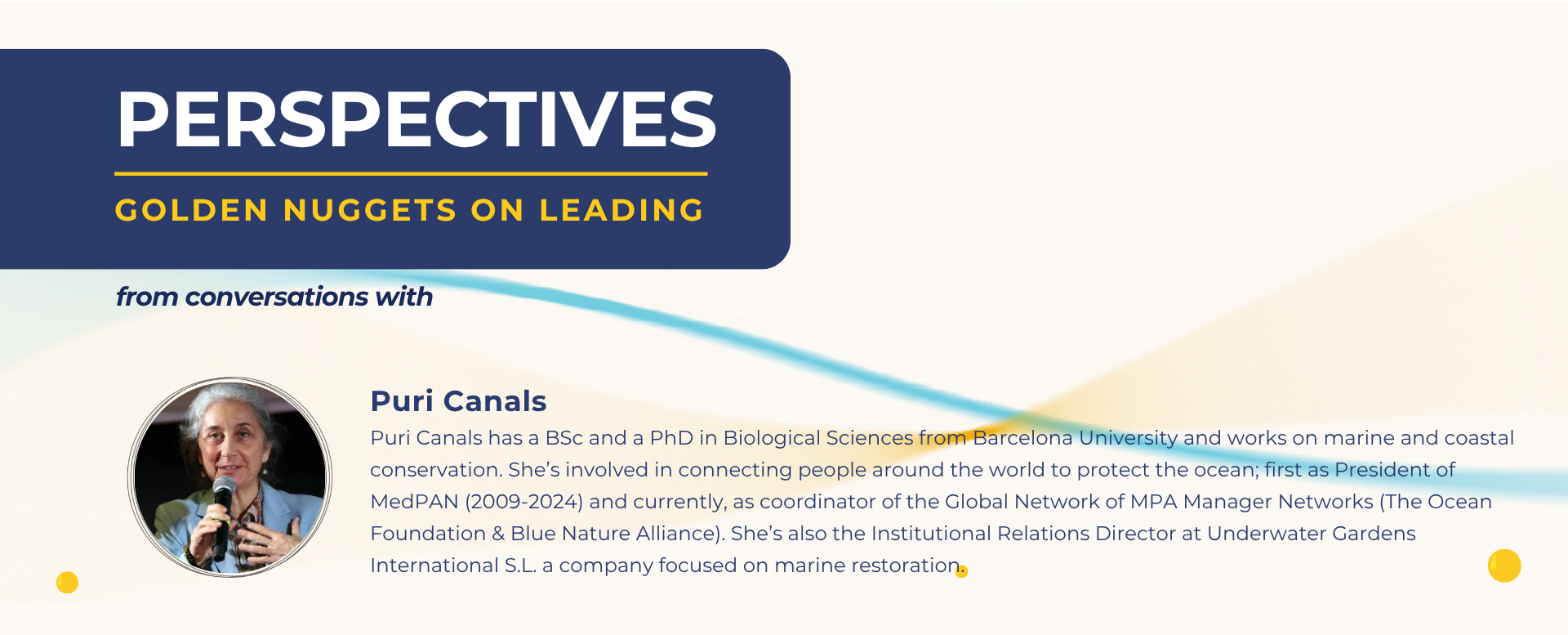
When conversations about leading focus on energy, they often revolve around how we create more of it. We talk about motivating teams, inspiring people or generating enthusiasm. But what if that’s the wrong place to start? What if energy is already there, waiting to move?
In this conversation with Puri Canals, a scientist, systems thinker and environmental leader, Julia Middleton discovers a perspective rooted in nature. Drawing on ecosystems, biology and decades of scientific research, Puri suggests that the role of someone leading is not just to generate Energy, but to remove whatever is preventing it from flowing.
When Energy Gets Stuck
Julia opens the conversation by reflecting on one of Women Emerging’s own discoveries: that leading is about generating energy. Puri immediately offers a gentle challenge. “I don’t think it’s so much about generating,” she says, “but allowing the flow of energy.” It is a subtle distinction, yet one that reshapes the conversation from the very beginning.
For Puri, whether we are looking at people, organisations or ecosystems, the same principle applies. “Most of the problems,” she explains, “psychological, social, physiological in our health, it’s related to the energy when it is stuck with this block.” Nature, she argues, is constantly teaching us that life depends on movement. A resilient ecosystem is not one with more energy than another; it is one where energy is allowed to flow freely. “Life is operating under the same principles at any scale we look at it,” she says. The challenge, then, is not finding more energy but understanding what is stopping it.
What Competition Teaches Us—and What It Doesn’t
As the conversation unfolds, Puri reflects on the education she received growing up in Spain during the Franco dictatorship. Success was measured by individual achievement. “I was motivated to be the first, to be the best,” she recalls, “to not necessarily cooperate with others because this was opposite to you being winning.”
Looking back, she sees how narrow that understanding of intelligence really was. Schools celebrated academic performance, logical thinking and examination results, yet overlooked so many other forms of human capability. “There are other dimensions of our intelligence that were not considered,” she explains. Empathy, working alongside others, dealing with frustration, physical intelligence—these qualities mattered just as much, yet they rarely appeared on a report card.
As life unfolded, Puri realised that success could not be measured only by individual accomplishment. “There’s many other aspects in life that are more relevant,” she reflects, “especially if you don’t look at successful results only for you. If you look at successful results for your community.” It is a reminder that cooperation is not the opposite of achievement. Sometimes it is the very thing that makes meaningful achievement possible.
Why Nature Always Finds Another Way
Searching for an image that captures this idea, Julia turns to water. Isn’t energy, she asks, a little like a river, constantly finding its way around obstacles?
Puri smiles at the comparison. “I like the example of water,” she replies. “Water connects everything and water always finds the way to reach the objective.” Unlike the competitive models many of us grow up with, water does not insist on forcing its way forward. Sometimes it flows gently around an obstacle. Sometimes it changes direction entirely. Yet it keeps moving.
For Puri, water also offers another important lesson. “Water,” she explains, “is also connected with our emotions.” Fear, she suggests, is one of the greatest causes of blocked energy. “When we are afraid… it’s the worst way to block our energy in our body.” When fear takes hold, people stop acting. They become defensive, cautious or disconnected from others.
The image lingers because it feels familiar. Many of the obstacles we experience at work are not created by a lack of ability but by uncertainty, fear or environments that prevent people from contributing fully. Like water, perhaps people need pathways more than pressure.
Looking at the Whole System
Again and again, Puri returns to the importance of seeing connections rather than isolated problems. Nature, she explains, does not operate in silos, yet that is often how we are taught to think. Scientists study ecosystems separately from physiology. Organisations separate departments. Individuals focus only on the issue directly in front of them.
“But in fact,” she says, “the principles in nature are always the same.”
Healthy systems maintain balance. They constantly adjust, respond and rebalance themselves. “This homeostasis is the basis of life,” Puri explains. “It’s what makes life resilient.”
For Julia, this raises an obvious question. If leading is about energy flowing through a system, what exactly is the responsibility of the person leading?
Puri’s answer begins with vision.
“The first thing is to see the vision,” she says. “What point do you want to reach?”
Only then can someone step back and look at the whole system. Where is energy flowing? Where is it getting stuck? Which parts of the system are helping people move forward, and which parts have become barriers? “Sometimes,” she explains, “you see the obstacle there in front of you, but there is an option one side, the other side, up, down. If you don’t look at the system, you cannot see the alternatives.”
It is a reminder that many problems appear impossible only because we are looking at them too narrowly.
Leading Is About Creating the Conditions
Running quietly beneath this conversation with Puri Canals is a challenge to many of the assumptions we hold about working with people. We often imagine that our role is to energise others, motivate them or push them towards a goal. Puri suggests something different.
Perhaps our responsibility is to notice where energy is being blocked. Perhaps it is to create environments where cooperation becomes easier than competition.
Perhaps it is to recognise that people, like ecosystems, flourish when balance replaces control and connection replaces isolation.
The role is not to become the source of everyone’s energy. It is to help remove whatever is preventing that energy from flowing.
What Nature Can Teach Us About Working Together
By the end of this conversation with Puri Canals, it becomes clear that nature is not simply a metaphor for better ways of working—it is a guide. Rivers, ecosystems and living organisms all remind us that resilience comes not from constant force but from movement, balance and adaptation.
Perhaps the most enduring insight from this conversation is that leading is less about pushing harder and more about paying closer attention. Where is the energy already present? What fears, structures or habits are stopping it from moving? And what might become possible if, instead of trying to create more energy, we simply helped it flow?