
Leadership advice is full of rules. Speak with confidence. Find balance. Learn to include everyone. Never make mistakes. Never let criticism shake you.
But what if many of those “rules” are myths?
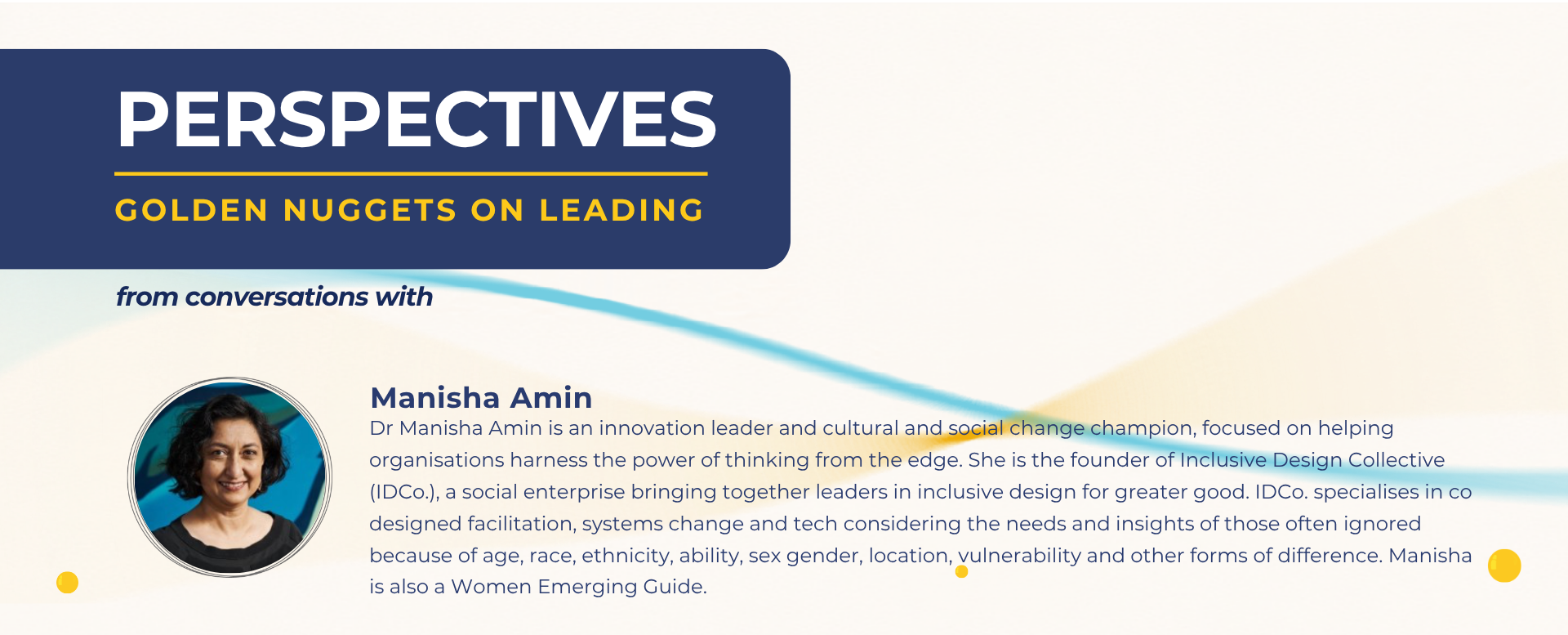
In this episode of the Women Emerging Podcast, Manisha Amin reflects on five objects that represent moments which fundamentally changed how she thinks about leading. Together, they reveal a different picture: one where vulnerability matters more than perfection, inclusion is learned through experience rather than intention, and criticism can become one of your greatest teachers.
Here are five myths worth leaving behind.
1. Stop believing you need to be perfect before you speak up
Many people assume confidence comes naturally. For Manisha, it didn’t.
Growing up with dyslexia meant spelling was a daily struggle. As a young marketer, she spent evenings rewriting work by hand, checking every word before taking it back into the office the next morning. She even lost opportunities because employers focused on what she couldn’t do rather than what she could.
The turning point came when she realised she didn’t have to hide behind written perfection. Instead, she found her voice through speaking.
The microphone she chooses as her first object isn’t just a symbol of public speaking. It’s a reminder that your greatest strength doesn’t always emerge in the area where you’re naturally comfortable. Sometimes it appears when you stop trying to prove yourself in someone else’s way.
Try this: Instead of asking, “Where am I weakest?” ask, “Where do I communicate best?” Your voice might not look like someone else’s—and that’s exactly the point.
2. Stop chasing perfect work-life balance
The steering wheel represents a feeling many professionals know all too well.
Driving home from work, your mind is still at the office. Arriving home, you feel guilty for leaving work unfinished. Returning to work the next morning, you feel guilty about what you didn’t do at home.
It’s easy to imagine everyone else has found the elusive balance we can’t quite achieve.
But Manisha challenges that assumption.
Rather than aiming for perfect balance every day, she learned to accept that different seasons demand different things. Some days work needs more of you. Other days family does. The goal isn’t equal time—it’s being intentional about where your attention belongs in the moment.
Try this: Instead of striving for balance, focus on presence. Ask yourself, “Where do I need to be fully present right now?”
3. Stop assuming inclusion is something you learn in a classroom
Many organisations invest in inclusion training, but Manisha’s understanding of inclusion came from somewhere far less conventional.
Homeschooling exposed her to people from completely different backgrounds, interests and communities. Later, a simple spray can of paint became a reminder that creativity often happens when different perspectives collide.
Real inclusion isn’t simply welcoming people who think like you.
It’s allowing yourself to be changed by people whose experiences are entirely different from your own.
That requires curiosity, humility and a willingness to step outside familiar circles.
Try this: Look beyond your usual professional network. The people who challenge your assumptions often become the people who expand your thinking.
4. Stop thinking collaboration happens automatically
Playgrounds might seem like an unusual place to learn about leadership, but for Manisha they became powerful classrooms.
Watch children for long enough and you’ll notice something fascinating. Some instinctively include others. Some dominate the space. Some quietly wait to be invited in. Others create games that everyone wants to join.
Those same behaviours don’t disappear when we become adults. They simply move into offices, meetings and organisations.
Creating environments where people genuinely contribute doesn’t happen by accident. It requires noticing who speaks, who doesn’t, who feels welcome and who quietly disappears from the conversation.
Try this: In your next meeting, pay attention to who hasn’t spoken yet. Inclusion often begins with noticing who’s missing from the conversation.
5. Stop seeing criticism as something to survive
Perhaps the bravest moment in the conversation comes when Manisha talks about receiving a complaint letter about herself.
Most people would rather forget moments like these.
Instead, she chose to examine it.
The experience reminded her that criticism isn’t always comfortable—but neither is growth. Not every complaint is fair, but dismissing feedback simply because it hurts means missing opportunities to learn.
The challenge isn’t to avoid criticism.
It’s to become the kind of person who can listen without becoming defensive, reflect without losing confidence, and decide what deserves to change.
Try this: The next time you receive difficult feedback, resist the urge to respond immediately. Ask yourself one question first: “What can I learn from this, even if I don’t agree with every word?”
A Different Way Forward
Leadership is often portrayed as a journey towards certainty: becoming more confident, more capable and more in control.
Manisha Amin’s reflections suggest something different.
The most meaningful growth doesn’t come from living up to impossible myths. It comes from understanding your own strengths, accepting your imperfections, staying curious about other people’s experiences and being willing to learn—even when the lessons arrive disguised as setbacks.
Perhaps that’s the biggest myth of all: that effective leadership is about having all the answers.
More often, it’s about having the courage to keep asking better questions.