Women talk about Miranda Priestly from The Devil Wears Prada as though they encountered her in yesterday’s meeting.
That’s partly because she was never entirely fictional in the first place. Loosely inspired by Vogue editor Anna Wintour, Miranda Priestly became far more than a movie character. She became a workplace archetype. So did Andy Sachs, trying to prove herself in a world she didn’t yet understand, and Emily Charlton, whose pursuit of excellence was inseparable from her desire for approval, and the rest of the Runway universe.
I feel the enduring appeal of The Devil Wears Prada is not really about fashion, or even Miranda herself. It is about the questions she leaves behind. Twenty years later, and with The Devil Wears Prada 2 bringing her back into our lives, we are still asking what her version of excellence cost, what it achieved, and whether it still has a place in the way women lead today. Julia Middleton opens the series of conversations around The Devil Wears Prada with:
“I think her approach to leadership has influenced many of us over the years, as we’ve decided what we do want to take from her and what we absolutely do not want to take from her…”
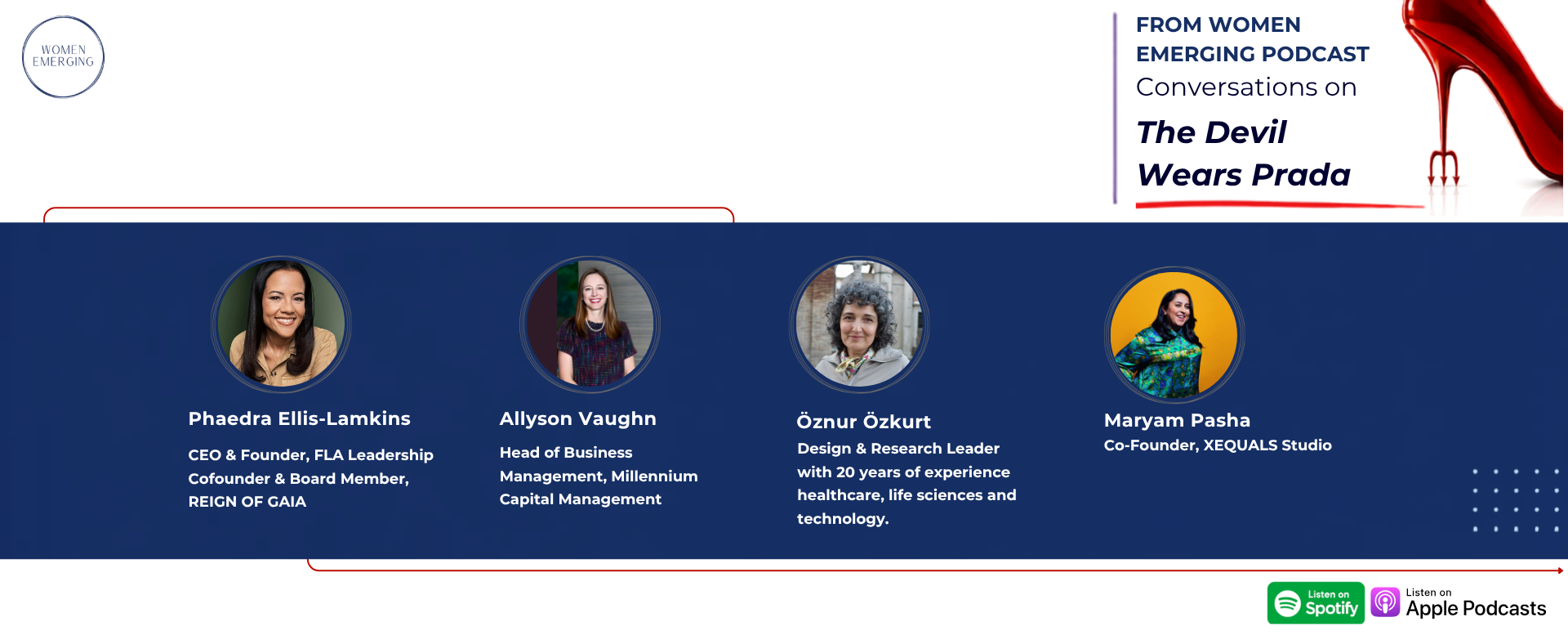
Through conversations with four successful women, who in Julia’s words “could all easily be Miranda Priestly in their own sectors today”, we explored how The Devil Wears Prada influenced the way women approach leading.
The Women Emerging team had been following the series alongside me, so I asked them two questions: What do you think about Miranda Priestly as a woman in a position of authority? And what was your biggest takeaway from the episode you listened to? Their answers revealed just how much the conversation around Miranda has evolved over the last twenty years.
Miranda Priestly Was Ruthless, or Simply Committed to Excellence?
The first episode challenged one of the most common assumptions about Miranda Priestly. Was she ruthless, or was she simply uncompromising in her pursuit of excellence? In conversation with Phaedra Ellis-Lamkins, Julia explored whether great leading sometimes requires a degree of ruthlessness, particularly when the mission is bigger than any individual.
Amy Stillman, Chief Operations Officer at Women Emerging, finds Miranda one-dimensional, she explains – “We don’t really know who she is, other than being a tyrant. Maybe that was the norm two decades ago, for women on their way to the top. But these days, I think women can bring the many facets of themselves to the workplace and still succeed brilliantly.” Amy found herself drawn to Phaedra’s reframing of the word “ruthless”:
“I loved Phaedra’s reframing of what we mean by ‘ruthless’. Defining Miranda’s behaviour as ruthlessly committed to the mission of her organisation as her highest priority removes the negative connotation and makes ruthless seem almost noble. We should all be so passionate and disciplined about the work we are leading. Also, though, this must be tempered by treating the talent in the organisation with respect.”
Kagiso Onkabetse, Operations Director at Women Emerging, approached Miranda from a different angle: “I see a woman who is deeply committed to excellence and unapologetic about her expectations. While I respect that, I don’t believe excellence and compassion are mutually exclusive. Love is at the core of my leadership, and I’ve learned that people can be challenged, stretched, and held accountable without being made to feel small.” Her takeaway from the conversation captured one of the central tensions of the entire series:
“The episode reminded me that leadership is not about being liked, but neither is it about being feared. The real challenge is staying committed to the mission while never losing sight of the humanity of the people helping you achieve it. You can move fast, get things done, make hard decisions, have difficult conversations, and even part ways with someone without stripping them of their dignity.”
Was Miranda Priestly Actually a Good Boss?
If Episode 1 focused on Miranda’s commitment to excellence, Episode 2 examined the impact that commitment had on the people around her. In conversation with Allyson Stewart-Allen, Julia explored whether Miranda’s leadership style was a necessary product of her time, or whether the cost to her team was simply too high.
Tshepo Moyo, Community Manager at Women Emerging, reflected on how differently she now sees the character: “Miranda is a fascinating and tragic case study of a woman who leveraged exceptional skill and strategic thinking to survive in a system that would have crushed her had she shown any vulnerability. But in doing so, she became complicit in perpetuating the same cruelty she likely experienced on her way up. While I understand the structural constraints she operated within, her choice to weaponize fear rather than build trust reveals how easily women in power can replicate patriarchal leadership models instead of imagining something fundamentally different.” The episode also sharpened a distinction Tshepo has been thinking about in her own work:
“This conversation really crystallized something I’ve been wrestling with in my own leadership work: the distinction between being mission driven and being mission obsessed, and how that line determines whether you build movements or just consolidate power. Miranda’s failure wasn’t really about her demands for excellence, it was her refusal to see that people are the mission, especially if we’re serious about transforming systems. Without fairness and trust, you don’t inspire change, you just create exhausted, fearful people who leave the moment they can.”
Can Miranda Priestly’s Version of Excellence Still Work Today?
By the third episode, the conversation shifted from understanding Miranda to questioning whether her approach is still viable. In a world that increasingly values psychological safety, wellbeing and collaboration, can fear-driven excellence still succeed?
Sonam Dave, Marketing Director at Women Emerging, reflected on both Miranda’s strengths and her blind spots: “I think Miranda was trying to lead and survive the cutthroat world of fashion and creativity, 20 years back, in the way she thought was right. It gave her the rewards of a brilliant network, an authority to command the trends in fashion and a wonderful skillset to manage up. However, the flip side of it is that her team does not feel seen, some are nearing burnout, and employees like Nigel do not get the due opportunity or promotion they deserve.” Her key takeaway focused on a very different approach to leading:
“I have two key takeaways: leadership requires knowing the whole person, it requires knowing your team’s stories, personal goals, and their ambitions. It also requires you to be vulnerable to share about yourself so that your team sees you as a whole person too. And two stable presence of a leader can be combined with vulnerability, to lead effectively. It’s not either or, its and.”
Are Women Forced to Choose Between Andy and Miranda?
The final episode brought the conversation into the present through The Devil Wears Prada 2. Together, Julia Middleton and Maryam Pasha explored a question many women still grapple with: must we choose between Miranda’s authority and Andy’s humanity, or is there another path altogether?
Brenda Mboya, Community Manager at Women Emerging, reflected, “Miranda Priestly takes a very authoritarian approach to leading that detaches emotional attachment to the team. This helps her achieve excellence yet builds it on a fragile foundation of fear and emotional distance amongst the team she is leading. She demonstrates that authority without vulnerability or genuine investment in people is ultimately a lonely and unstable place to lead from.” Her key takeaway from the episode was:
“The key takeaway from this episode it the trap many mid-career women fall into i.e. the mentality that one needs to still prove oneself or Miranda’s extreme (hard, closed-off, excellence at all costs). The healthier path, which the episode gestures toward, is to own your value and expertise while remaining collaborative. Leading, isn’t about dominance, but about knowing when to hold your ground and when to genuinely let people in.”
Success Lawal, Marketing Executive at Women Emerging, was left reflecting on a different question, “What always strikes me about Miranda Priestly is that she represents a question many workplaces still wrestle with: Does excellence require intimidation? While she is undeniably effective, the experiences of people working with or under someone leading should also be prioritised alongside performance.” And from the episode itself:
“The episode with Maryam Pasha left me thinking about how often women in leadership are forced into false choices; Miranda’s ambition and Andy’s empathy are treated as opposing traits, yet leadership should not require us to choose between excellence and humanity. It reinforced my belief that excellence and humanity are not opposing forces and that great leadership makes room for both.”
Perhaps that is why The Devil Wears Prada has endured for two decades. Not because it gave us the perfect model of leading, but because it captured questions women are still wrestling with today: How do we pursue excellence without losing ourselves? How do we hold power without becoming consumed by it? And how do we lead in a way that is both effective and deeply human? The answers may have changed since 2006, but the conversation is far from over.
What do you think about Miranda Priestly, or perhaps Andy, Emily or Nigel? Leave a comment below and join the conversation.
If you’d like to see more series like this, let us know what films, books, characters or cultural moments you’d love us to unpack through the lens of leading. In our next series, on the podcast, we’ll be exploring women’s journeys to leading. Until then, keep exploring.






One Comment
A powerful reflection. Andy’s journey reminds us that success is not only about achievement but also about staying true to who we are. Thank you for exploring leadership through such a meaningful lens. Looking forward to the next series.