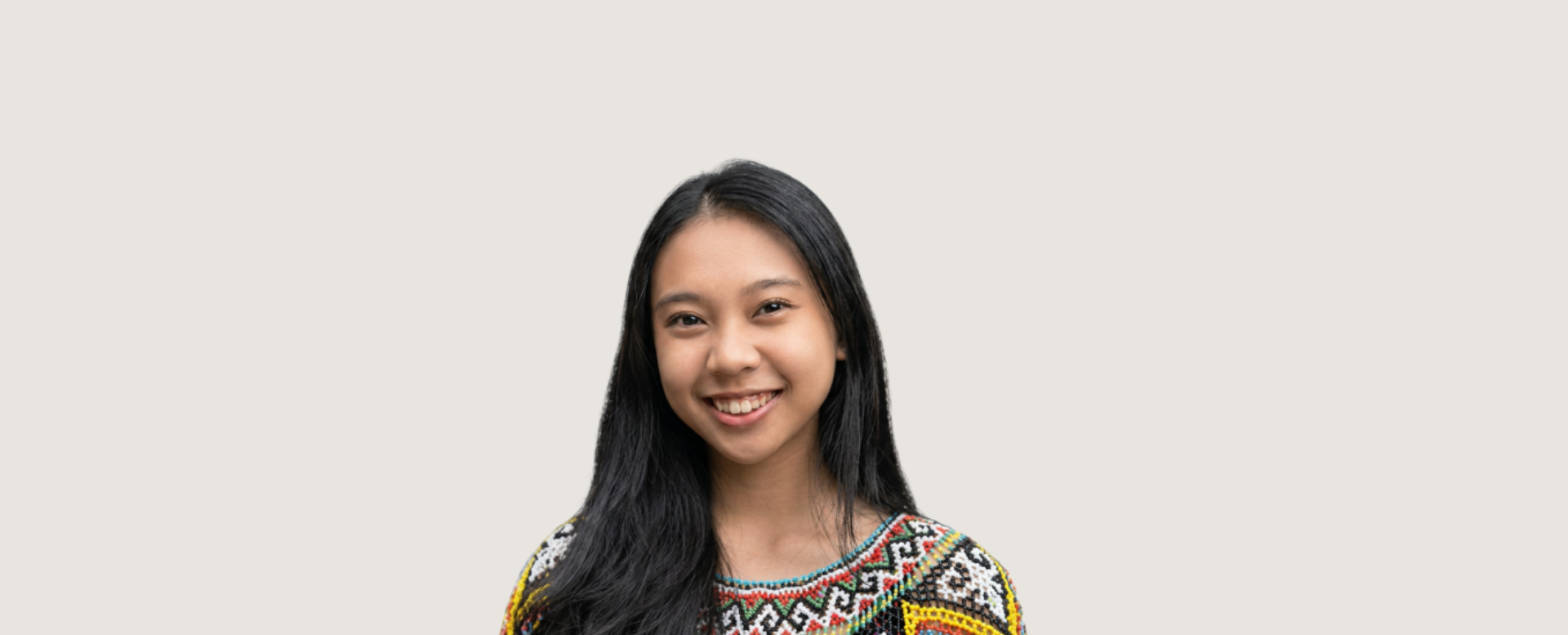
A Changemakers Expedition conversation with Laetania Belai Djandam, a climate justice activist from Borneo, Indonesia.
On a recent Changemakers Expedition Guide call, Laetania Belai Djandam held up a mask. Not a metaphor she reached for on the spot, but a physical thing she had crafted by hand in her own Expedition journey, its surface mapped with the dualities she carries into the rooms where global change gets argued over. Across three parts of the face, the mind, the eyes and the mouth, she had worked through the question that follows so many young women into spaces they were told to be grateful to enter: How do you lead without compromise yourself? What follows is drawn from that conversation.
You brought a mask to explain how you lead. Start at the top, with the mind.
For me the mind is a weave, and it is rooted in the traditional Indigenous practice of weaving I grew up around. Leading well is not about handing down directions from the top. It is the art of recognizingthe different dimensions, histories, strengths and weaknesses in the people around me, and weaving their Essence, Elements, Expression and Energy into one collective. The shadow side is isolation. I reject the heroism complex, that Western notion that a single person can or should save a community. The weight has to stay shared and communal. To lead in isolation is to break the weave.
You cut viewing windows into the mask for the eyes. What are they for?
Sight has to stay fiercely grounded in the raw reality of the community you come from. The eyes are an outward window, to witness suffering honestly, and at the same time an inward mirror, for constant self-reflection. The shadow is the noise. We live in an era of so much of it that it becomes dangerously easy to fear the truth, to scroll past systemic atrocities, skip the uncomfortable reflection, or disassociate from local struggles once you are sitting in elite global circles.
And the mouth?
The mouth is where the spoken word lives, and it has to do more than one thing. It has to hold the tender acts, healing, nurturing and honouring, alongside the fierce ones, challenging, uplifting and actively disrupting what is there. The shadow here is specific to young women. We are conditioned to battle our own doubt, to fear being too loud, too demanding, too much for a traditional room. That internalised fear can paralyse the words before they ever get the chance to challenge power.
Teodora asked what you have to leave behind to stay authentic. What came up?
This cut to something I feel sharply. Indigenous and grassroots people travel to international summits, the United Nations Climate COPs and the like, to fight the material extraction of our lands. But on top of all the emotional, financial and physical burden of having to travel and carry the aspirations of our communities, there’s a similar level of extraction that these spaces take from us. We cannot let ourselves continue to be extracted in our souls the same way that our land is being extracted.
What I have to leave behind is the good girl complex. We are raised to be polite, accommodating and perpetually available, and so we feel a deep guilt for saying no, as if missing a single panel means we have failed something structural. Shedding that compliance is a condition of survival. Protecting your energy, drawing hard boundaries against institutions that demand your vulnerability without offering any real shift in policy, and redirecting that focus toward caring for your own community, that is not a loss. It is a sustainable victory.
A closing question from the call: in an age of algorithmically curated media, how can a woman be sure her inner essence is truly her own, and not just a byproduct of what she consumes?
I would push back on the premise a little, with a kind of radical acceptance. The spaces we inhabit, the art we witness, the knowledge we absorb, these are not external pollutants to filter out. They are dynamically woven into who we are. And essence is never static. My own inner map was once defined only by my ancestors and the natural world. Now, with my marriage ahead of me and the hope of a family, a new element is arriving, a sense of motherness. The real challenge is not the paranoid filtering of outside influence to keep some artificial purity. It is giving yourself permission to grow, shiftand fluidly adapt across the different seasons of your life. Women are multidimensional, and we are so much more than the labels that these conferences and institutions put on us. It’s okay to embrace that multidimensionality instead of always feeling like we need to be one thing to belong.
About the Guide
Laetania Belai Djandam is a young Indigenous climate justice advocate from the Dayak Ngaju-Ma’anyan tribe in Indonesia. She has long been active in climate and health advocacy across local, national, and international platforms, grounded in the intergenerational wisdom of protecting both nature and culture.
Building on her earlier role as the inaugural Chair of the Associate Board, Belai currently supports Health in Harmony’s advocacy efforts in championing rainforest community-led solutions, reimagining climate and health policy beyond colonial and siloed systems, and centering Indigenous leadership in global decision-making.