
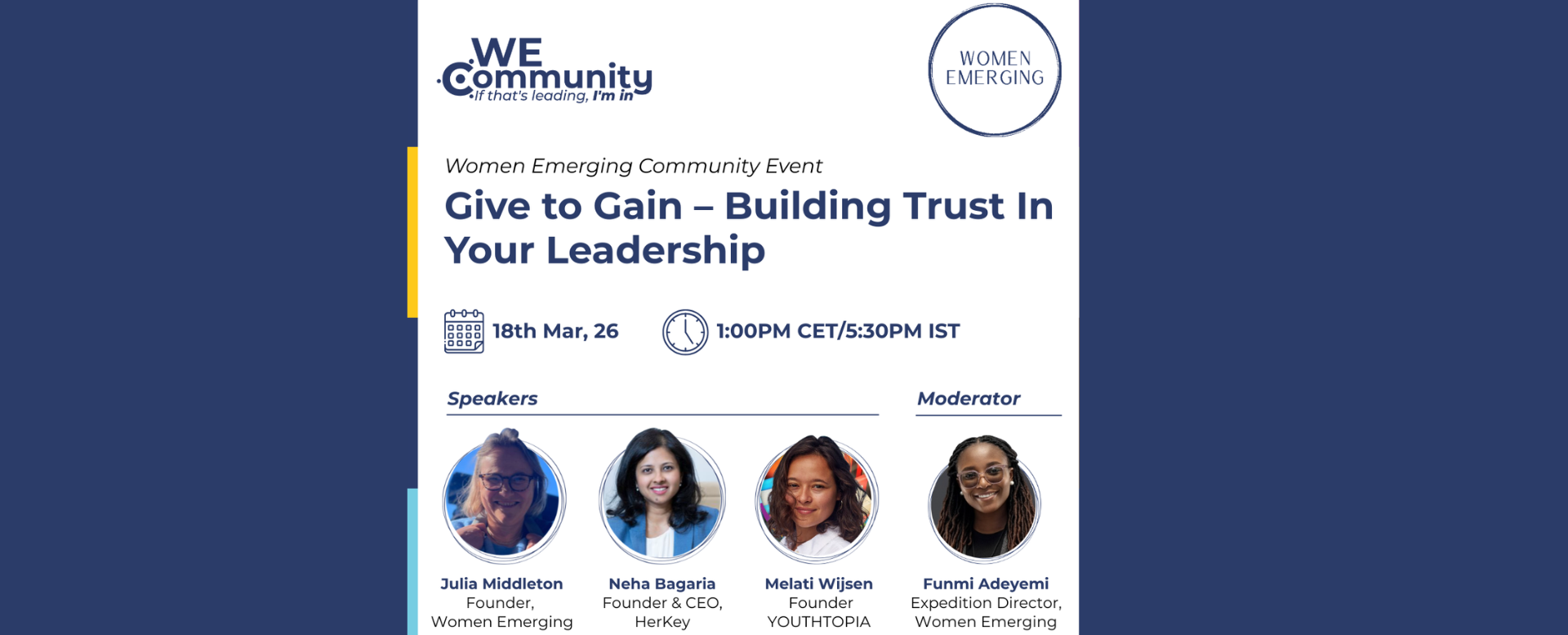
On 18th March 2026, the Women Emerging community hosted its first community event, bringing together about 70 women from across geographies, sectors, and generations to explore a theme that feels both simple and deeply complex.
Titled Give to Gain: Building Trust in Your Leading, the session featured Julia Middleton, Founder, Women Emerging; Neha Bagaria, Founder & CEO, HerKey; and Melati Wijsen, Founder & CEO, YOUTHTOPIA, and was moderated by Funmi Adeyemi, Expedition Director, Women Emerging.
The conversation turned out to be an honest exploration about what builds trust and what it really takes to rebuild it.
Does trust come automatically with a role or position?
The session began with a simple question: does trust come automatically with a role or position? The answer was clear. It does not. Trust has to be built, and built intentionally.
This framing shaped the conversation that followed. Trust is not something that comes with a title. It is formed over time, through how people experience you. Neha reflected on this through her work with women returning to work. What appeared straightforward, that people would simply come back and resume, proved far more complex. People returned with different pressures, responsibilities, and expectations. Building trust in this context required patience, a willingness to listen, and a recognition that one approach would not work for everyone.
Melati added to this by drawing on her experience of leading a global community from a young age. Trust, in her context, was not one-directional. It involved both being trusted and trusting others. Creating space for people to lead in their own environments, while still holding a shared direction, required a careful combination. Trust was not about control, but about enabling others within clear boundaries.
Julia then shifted the lens from trust to trustworthiness. Instead of asking how trust is built, she focused on what makes someone worthy of it. The answer lay in behaviour. Giving credit without hesitation, acknowledging others’ contributions, and offering genuine admiration without attaching it to personal gain. These were not large or dramatic actions, but consistent ones. Equally, trust could be undermined in small ways. Taking credit, overlooking contributions, or failing to notice the work of others. As Melati noted, trust is not what you say. It is what people experience.
The conversation also explored authenticity, but not in a simplistic way. Neha spoke about the importance of being real, especially while balancing multiple responsibilities. Julia challenged this by questioning whether authenticity alone is enough, asking what it means if someone is “authentically horrible”. The discussion made it clear that authenticity, while important, needs to be accompanied by responsibility and awareness of its impact on others.
What does it take to build and rebuild trust?
The discussion then moved to what it takes to sustain trust over time. One idea stood out early. Passion is not enough. As Julia pointed out, “Passion is not enough to trust someone… build that knowledge before acting.” Passion, without knowledge, can limit perspective. It can lead to action without sufficient understanding. Trust, on the other hand, requires grounding. It requires learning, effort, and the ability to see beyond one’s own viewpoint.
This led to an important shift in thinking. Trust is something others extend. Trustworthiness is something you practise. The focus moves from whether people trust you to whether you are behaving in ways that make you worthy of trust.
The conversation then turned to the challenge of rebuilding trust. Melati shared how trust can break in team settings when expectations are not met. Neha reflected on how the pandemic placed additional strain on trust, particularly for women managing multiple responsibilities. In both cases, the same pattern emerged. Building trust takes time but rebuilding it takes even more.
Julia added a critical dimension. Rebuilding trust is difficult because it is not only about others trusting you again. It is also about you trusting yourself again. This requires acknowledging where things have gone wrong and working through that discomfort.
It also requires deliberate practice. As she acertained, “Trust is not fragile, it is solid, but you have to really practise apologising.” Rebuilding trust is not driven by intention alone. It depends on consistent behaviour. Acknowledging mistakes, responding quickly when trust weakens, and demonstrating through actions that change has taken place.
The discussion also touched on the internal side of trust. Neha spoke about imposter syndrome and the challenge of stepping into leadership roles with self-doubt. Building trust begins internally, by addressing these doubts, and then extends outward through consistency and time. Melati emphasised the role of community in this process. Trust is easier to build in environments where people can learn from one another, share experiences, and grow together within a supportive structure.
As the conversation closed, one idea remained clear. Trust is not built in a single moment. It is built over time, through small, consistent acts. And once broken, it can be rebuilt, but only with effort, awareness, and sustained practice.