
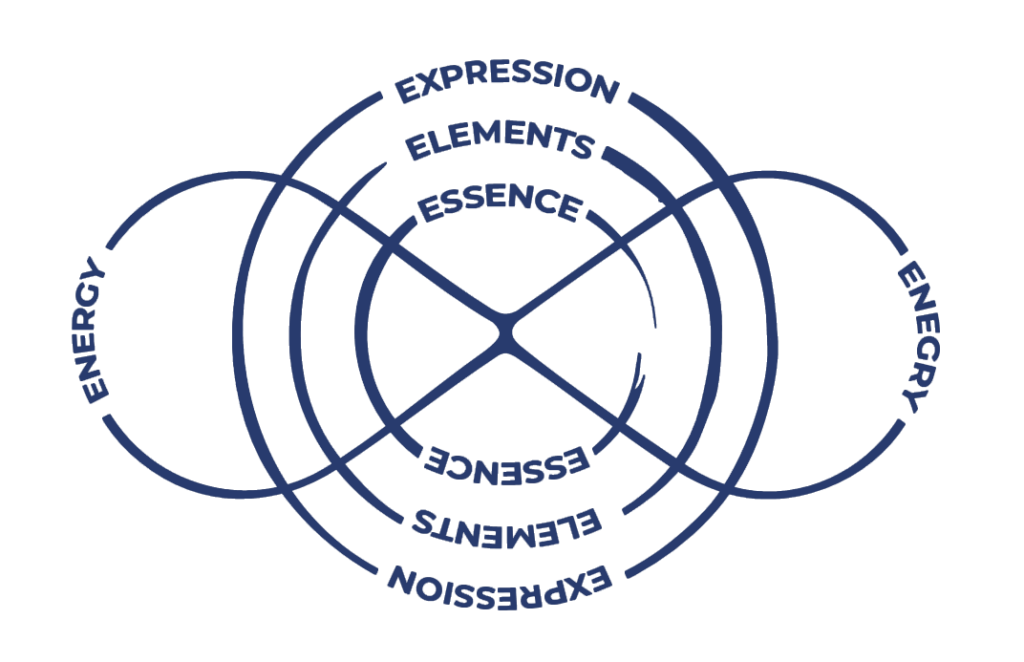
We are four months into our expedition. We started with Essence and went on to look at the Elements that emerge from our Essence. Elements that:
- Helpfully, are the Elements to take joy in, that frame our leadership, power it, root it, give it shape and resilience, and make it inspiring and exciting.
- Less helpfully, are the Elements to jettison. Those that get in the way, hold us back, even drag us down.
- And the Elements to reframe. The ones we have been told for years are our weaknesses but actually need recognising as our strengths.
Also last month we looked at why we lead as philanthropists, why we don’t just stick to making donations. Explorers captured their answers to this question on the last call. One Explorer added this answer last week:
“Because I owe something to those before me, which I repay by building things that outlast me”.
Over the last month, Explorers have turned to another aspect of Elements: those Elements that need combining. Often Elements that may at first feel like opposites, uncombinable opposites. Explorers captured their learnings from the month in powerful written accounts which they shared before our call.
Some big ideas stood out for me from these write-ups:
- One Explorer said she was resolved to stop wasting time trying to reconcile the combines.
- Another Explorer talked about the challenges of combining Vulnerable and Strong. She reflected that she is open and vulnerable to her immediate circle, but walled off to others. And that she should stop splitting herself by audience.
- One Explorer reflected on why Western Explorers seem to put being a good girl on their jettison list. “Why is breaking away so valued in the West?”, she asked.
- Another Explorer wanted to reframe leadership itself. She said she had always thought of it as “direction, responsibility and decision making”. She sees it now as “being emotionally present, listening deeply, connecting on a human level and recognising that you don’t exist without the collective”.
- Many Explorers said that their discussions on combining had taken them back to revisit their jettison and reframe lists.
Notable additions to the jettisoning list were:
- Taking responsibility for outcomes that rightly belong to others
- Carrying or rescuing people
- Over accommodating
- Seeking approval
- Over explaining
- Being over diplomatic
- Minimising own concerns
- Being judgemental
- Jumping in too fast
And notable additions to the reframing list were:
- Being emotional, after all it drives philanthropy — it is a strength not a weakness
- Boundaries reframed as self-care not selfishness
- Silence as leadership
- Directness as respect
- Letting go as trust
I suspect Explorers will be regularly revisiting their jettison and reframe lists as the Expedition continues. I hope they add the Elements to take joy in as well, that emanate from their Essences and that make their leading all the more effective.
So what then happened on our call last week? Explorers chose to focus on four combines and how to do the combining of them.
Drive and Patience
Getting this combine right feels important in philanthropy because:
- Some Explorers admitted to suffering from an allergy to patience, seeing it as laziness, avoidance or lack of commitment. They see drive as being tenacious and admirable.
- In some cases, the journey is almost as important as the outcome.
- There is a cultural dimension which is difficult. In different places, perceived overdrive prevents anything from happening.
- In philanthropy, a lot is hard to quantify and there are few final outcomes.
- Some Explorers talked about their focus on results and process-orientated outcomes and how hard it is to recognise that you are leading in a place that is very different from the one you grew up in.
Thoughts on how to get the combine right:
- Understand cultures, even if it’s to the level of judging how many and how often to send follow-up emails.
- Drive inside is fine, an inner heat. It should not always set the pace.
- Make sure it’s drive and not just busyness.
- Ask yourself questions. What is my inner narrative around patience? Am I driving just for the sake of driving? Am I being over patient and is this genuinely avoidance? Am I allowing people to go at their own pace? Am I listening hard enough to sense when to lean in or lean out?
- Surround yourself with people who sit naturally at one or the other end of the combine.
- Determine to resist resolving uncertainty but rather to live with it.
- Some Explorers commented on the restlessness in western psychology.
Empathy and Boundaries
Getting this combine right feels important in philanthropy because:
- Empathy means your instincts are to put out all fires. You have to have rules otherwise you will burn out yourself.
- If you feel too deeply, you cannot contain your own feelings. Empathy is like a muscle, the more you practice it the more your body will support you. But you can go too far.
Thoughts on how to get the combine right:
- Journaling is helpful and doing it in handwriting. Capture both deep thoughts and today’s actions.
- Schedule in self-care. Identify “my time”.
- Give yourself grace. Do the inverse of the golden rule: “Be kind to yourself as you are kind to others”.
- Have some “pre-packaged” responses like “I will come back to that” so that you don’t get sucked in.
- Define personal policies, red lines and non-negotiables.
- Take how you are with your own family as an indicator. Maybe you have empathy for everyone but them. The red flag is when you don’t take empathy home or give it to yourself.
- Be positive about the small things you achieve so that you don’t bury yourself in “I’m not doing enough”.
- Know it’s OK not to feel empathy every day. There are times to step back and not feel guilty. It’s not being selfish, it’s showing empathy to yourself. It is not that you are indifferent to others.
- Empathy should be joyful.
- Make sure you can receive empathy from others, even if it is hard. When you ask for help, ask people you trust and ask them to look at the situation from your perspective.
- Frame empathy as the energy to resolve issues, not just to be miserable. The empathy is not to raise emotion but to find ways forward.
- Show empathy by saying the tough stuff, not to hurt but to help. To find a solution or accept a situation.
- Boundaries are not just to protect yourself, they are to make sure your giving remains honest.
- Try to find self-worth as defined by yourself rather than others. And stop living in reaction to others’ expectations and boundaries.
- Recognise that leading is not about giving endlessly and solving everything. It requires trusting others and self.
Humble and Visible
Getting this combine right feels important in philanthropy because:
- If you are too humble, you can be perceived as lacking in transparency and may fail to lead.
- If you are too visible people assume you have a big ego. You also make yourself vulnerable to criticism, ridicule and possibly violence. And you can feel your personal space is being invaded. You also worry that people will only ever want you for money.
- Yet you need to be humble enough so that people don’t think it’s all about you and visible enough so that you can genuinely lead.
Thoughts on how to get the combine right:
- Know that every Explorer is uncomfortable with visibility.
- Know that you must overcome this if for no other reason than to draw attention to issues and encourage others to give. You are leading by example and want to bring others with you.
- Know that you choose visibility for a purpose, then the cost to yourself is something you can carry because it is worth it. Accept being a role model because it’s worth the discomfort.
- Be visible, accept the credit, because otherwise you don’t break the cycle of women stepping back and men claiming the credit and interpreting the success in their own way.
- Work on courage to be more visible and not let humility dominate. Take small steps first.
- Get your head around being cheesy!
- Surround yourself with a few trusted people who will tell you if your humility is sliding away.
Harmony and Conflict
Getting this combine right feels important in philanthropy because:
- Without combining both it’s hard to make progress.
- Harmony comes as a result of resolving creative tension, it’s part of the journey to harmony.
- Some Explorers say they seek out harmony and are afraid of conflict. Others look for it.
Thoughts on how to get the combine right:
- Airing conflict means you are halfway to addressing it.
- Things often have to fall apart to then come together. It is the role of the person leading to give people the confidence to believe things will come together. People need to be held.
- If you are in harmony, why is leadership needed? Conflict gives you an opportunity for leadership and creates more room for innovation.
- Don’t think whatever conflict there is should be your responsibility to resolve. Don’t take all of it on yourself. Find allies to carry it with you.
- Check with yourself whether it makes sense to battle. But sometimes when you have harmony, aim back into conflict. Stop struggling with yourself, live with conflict.
- You may be naturally peaceful but you also want to do what you believe is right.
- Be aware of what in your Essence pushes you naturally to one end or the other. Only by doing so can you break patterns, and breaking your own patterns is hard to do. Ask yourself what in your Essence is getting in the way.
One Explorer made a list of the important things to remember on Elements to combine, which she expressed as polarities that both need to be held and moved between. Here is her list, which I think I took the liberty of adding to:
- Both sides have value, neither should be permanently chosen.
- Mastering comes in the movement between the two without letting one dominate.
- One cannot be at the expense of the other.
- Recognise where you lean naturally and reprogramme yourself.
- The aim is not 50:50.
We spent the rest of our call moving on to the third E: Expression. We reflected on the dangers of abandoning all Essence and Elements as we actually start to lead and feel the need to fit in. To adopt other people’s approaches to leading, which can feel at odds with our own Essence and Elements, with how we lead and what we know works best, at least for us.
The trouble is that such disconnects between the Es often result — over time — in us getting stuck, walking away, burning out or becoming someone we don’t want to be.
But when the Es are aligned — with Essence reaching outwards to frame, root and sustain Expression and Expression reaching inwards to challenge, refresh and enhance Essence — it’s then that energy starts to flow and generate ever more energy.
To unpick Expression over the next month, Explorers will be working in small groups on leadership situations they have come across themselves. Looking into how Explorers might have used Essence and Elements thinking to address them. Each Explorer will then draw personal learning under the headings of what they should stop, start or continue to do as they lead, ready for our next call.
There was a raw moment during our call last week when one Explorer shared her overwhelming sense of overwhelm. Her sense of drowning. She stopped us all in our tracks — stopped our introspection, halted our momentum — as we all recognised what another Explorer in the group shared:
“We all have times when we lose the ability to function and everything falls apart”.
This expedition is a joy and honour to lead. I am very proud to be part of this extraordinary group of women.
About the Author
Julia Middleton is the host of the Women Emerging podcast and a best-selling author of “If that’s leading, I’m in” as well as two previous books: “Leading beyond Authority” and “Cultural Intelligence”. She is deeply committed to helping people from all backgrounds to find their own approach to leading. In 2020, Julia launched Women Emerging and in 2022 she lead an expedition of 24 women to find ‘an approach to leading that resonates with women’. She now leads expeditions with women all over the world based on 4Es methodology, discovered in the first expedition.
Prior to that, Julia was founder and, for over thirty years, Chief Executive of Common Purpose, which grew to become one of the biggest leadership development organisations in the world. Julia is also an Ambassador for the Aurora Prize based in Armenia, on the boards of Alfanar Venture Philanthropy in the Arab World and Equality Now, which operates globally, and on the Advisory Councils of Fundacao Dom Cabral in Brazil and Synapse in Pakistan. Born in London and brought up in New York, Julia was educated at French Lycées and graduated from the London School of Economics. She is married, with five children and seven grandchildren.