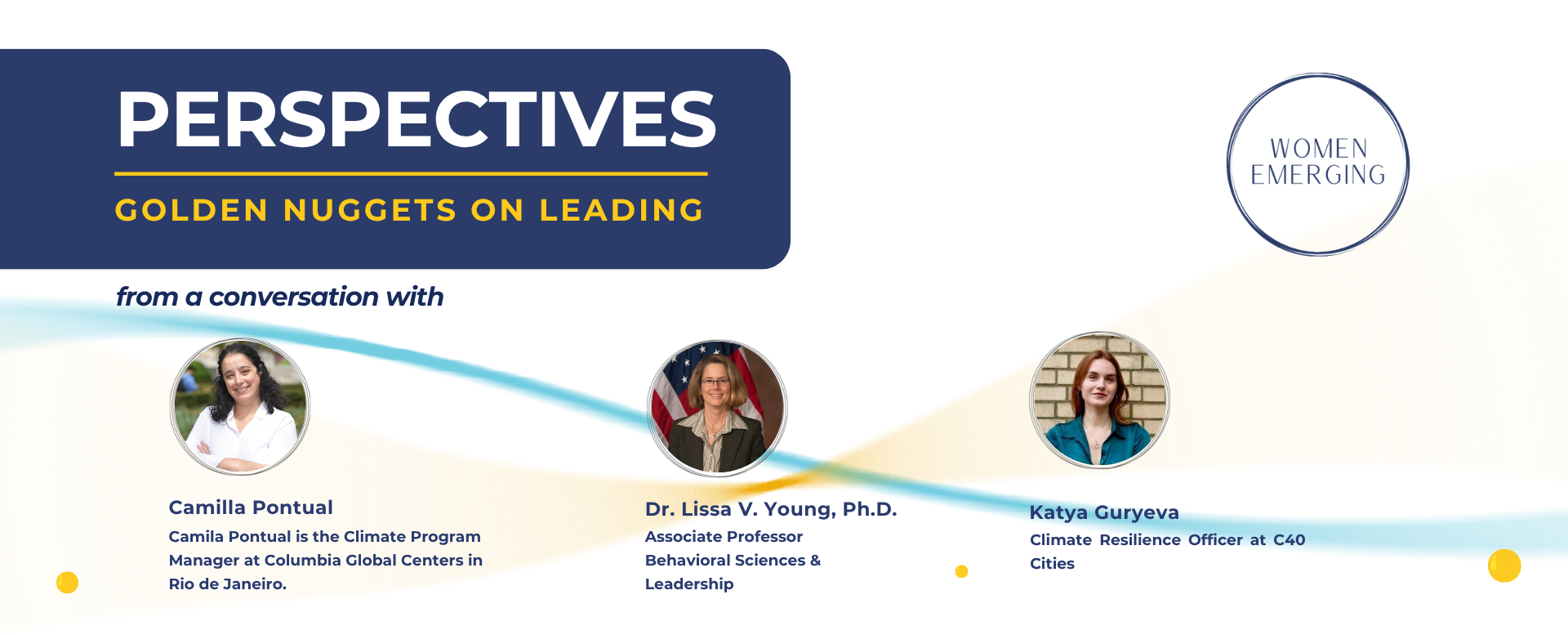
“The fact that there’s no silver bullet, that’s the outcome. Leadership is much more complex, and the reality is much more complex.” – Camilla Pontual
Perhaps disruption begins when we stop looking for the answer.
In this episode of the Women Emerging Podcast, Julia Middleton explores what it might mean to disrupt the way we think about leadership. Not disruption for the sake of disruption, but the kind that makes us question assumptions we have become too comfortable with.
Camilla Pontual starts by challenging the way women’s leadership is often talked about. She has taken part in many women’s leadership programmes and, while she recognises the value of the networks and connections they create, she finds herself frustrated by how often they rely on a very particular idea of what leadership looks like.
Women’s leadership is frequently described through a familiar set of words: collaborative, caring, inclusive. But what do those words actually mean in the daily lives of women? And whose reality are we using to define them?
For Camilla, much of the thinking around leadership remains centred on European and North American experiences. When those ideas are transferred into other cultures, they do not necessarily resonate.
She gives Brazil as an example. Women are already leading families and communities, particularly in poorer communities. Yet traditional ideas of leadership can still make the CEO sitting in a boardroom the image of the leader, while overlooking the woman who is leading a household, a community or a family every day.
That raises a bigger question. If leadership is supposed to create change, can we really separate leadership from the realities around us?
Camilla does not think so.
For her, leadership has to be connected to social change. It is difficult to talk about developing women’s leadership while ignoring the huge differences in the lives of women within the same country. A leadership group made up only of women from one section of society cannot, on its own, represent the reality of all women.
And perhaps this is where disruption becomes important.
Because if we are serious about rethinking leadership, we cannot simply create another model and expect it to work everywhere. There is no single pathway. There is no silver bullet.
What there can be is a common prism. Something that allows women from different contexts to look at leadership through their own experiences, rather than asking everyone to look through the same lens.
But if we are going to disrupt leadership, we also have to be willing to be disrupted ourselves.
That is why Julia brings Lissa Young into the conversation as the expedition’s disruptor. Lissa’s role is to notice when the group is becoming too comfortable, when its thinking is not quite adding up, or when everyone is being a little too nice to each other.
Lissa has spent much of her career inside the US Army, and she has learnt that changing a large institution is rarely as simple as standing outside it and demanding change.
Large institutions, she argues, often cannot hear complaints from the outside very well. Change can be more effective when someone inside the institution, someone who is trusted and understands how it works, can say: I see a gap here. I think we need to move in a different direction.
But that does not mean the outside is unimportant.
In fact, Lissa believes real change requires both. The people inside need relationships with the people outside who are challenging the system. The outsiders bring perspectives that the institution may not be able to see. The insiders can translate those demands into a language the institution can hear.
It is a relationship across what Lissa calls the institutional membrane.
Sometimes, she says, that relationship needs a disruption powerful enough to create what she calls cognitive dissonance.
Her example is the history of gay people serving in the US military. When gay soldiers began to come out openly, people inside the military were forced to reconcile two things they had previously kept apart: someone could be gay and also be a respected, effective soldier.
The contradiction became harder to ignore.
And that is what disruption can do. It can make it impossible to continue holding on to two ideas that no longer fit together.
But Lissa is also careful about the idea of breaking things to create change. She believes strongly in the institutions she works within and does not believe in destroying them simply so that they can be rebuilt. Sometimes the most effective disruption is not the biggest explosion. It is knowing what to challenge, when to challenge it and how much discomfort is necessary to make people look again.
That question of discomfort runs through the whole expedition.
Lissa is not only there to disrupt the group’s thinking. She challenges the idea that leadership itself needs to be gendered. For her, there are principles of good leadership and good ways of working with teams that do not belong to one gender.
And then there is another disruptor: difference.
The women on the expedition come from different sectors, backgrounds, beliefs and life experiences. They also think differently. Some think in big pictures. Some focus on detail. Some are quiet. Some are noisy.
And they are different ages.
Julia sees this as an important part of diversity. Young people can remind older people of what they have forgotten. They can show us things we might never have thought of ourselves.
Katya Guryeva, the youngest member of the expedition, explains why she thinks young people have something particular to contribute. Young people are still asking questions. They are less likely to take things at face value. They are not only interested in asking why the world is the way it is. They are asking how it could be different.
That matters.
Especially because, as Katya points out, her generation has grown up in a world with fewer fixed boundaries between countries and cultures. Her own education brought together young people from different countries, socioeconomic backgrounds and places with histories of conflict. Living and learning alongside them changed the way she understood the world.
When she encounters a story about another country, she can connect it to someone she knows. The issue becomes human.
And that makes it much harder to see the world in simple, black-and-white terms.
For Katya, that experience created an appreciation for nuance. There can be many truths behind a conflict. There can be many ways of understanding history. There can be many ways of being a citizen of a country.
That, too, is disruption.
It is the disruption that happens when another person’s experience makes our own understanding more complicated.
And perhaps that is what Julia means by “well-led discord”.
Difference does not automatically create innovation. It can just create disagreement. The challenge is to create enough trust, curiosity and openness for disagreement to become useful.
Because when different perspectives meet, something new can happen.
The expedition, then, is not trying to arrive at one neat definition of leadership. It is trying to create the conditions in which leadership can be questioned, challenged and reimagined.
As Julia reflects at the end of the episode, this is not disruption for disruption’s sake. It is because things have to change. They will not change if we continue with the same ideas and the same people leading in the same ways.
We need new blood.
We need more women to look at leadership and think: if that is what leadership can be, I’m in.
But to get there, perhaps we first need to disrupt the definition of leadership itself.
And perhaps the most useful disruptor is not the person who has all the answers.
It is the person who is willing to make us uncomfortable enough to ask better questions.