A team can be full of brilliant people and still fail to create something brilliant together. What makes the difference is not simply talent, but what happens between people: the energy, the connection, the shared purpose and the freedom to contribute.
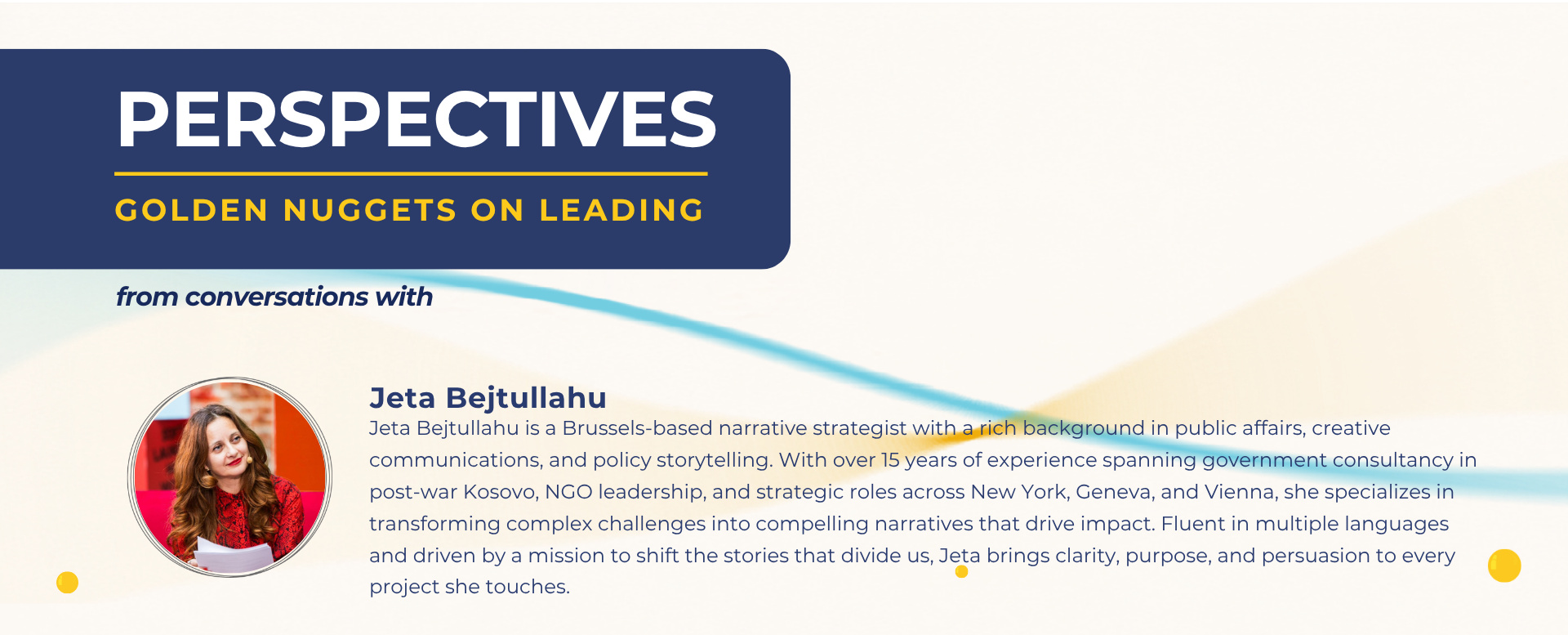
That is where Julia Middleton’s conversation with Jeta Bejtullahu begins. For Jeta, a dancer as well as a professional working with teams, the answer lies in an unexpected place: blues dancing. Unlike the more prescriptive Lindy Hop, blues gives dancers enormous freedom within a clear rhythm. Everyone brings their own energy, but nobody dances alone. For Jeta, that becomes a powerful way of understanding how fluid teams work.
Freedom Needs a Rhythm
Jeta’s move from Lindy Hop to blues was not simply a change in musical preference. It changed how she understood connection.
Lindy Hop gave her technique, structure and defined movements. Blues offered something much less prescriptive. There was still a boundary—the rhythm, the music and the connection between the dancers—but within those boundaries, the possibilities were open.
As Jeta explains, “You can know all the technique in the universe, but unless you’re dancing to the same rhythm and you’re feeling the rhythm, you’re not going to make it.”
That distinction becomes central to the way she thinks about teams. Freedom does not mean the absence of structure. In fact, freedom becomes possible because there is something holding everyone together.
In a team, that might be the purpose, the values, the objective or the shared understanding of why the work matters. Once those are clear, people can bring their own judgement, skills and ways of working to the task without needing every move prescribed for them.
Jeta describes it simply: “You have freedom, but there are rules.”
It is an idea that challenges two common approaches to teams. One is to control everything: define the process, make the decisions and expect people to follow. The other is to mistake autonomy for a free-for-all. Jeta’s experience suggests something more useful sits between the two. Give people enough structure to know where they are going, and enough freedom to decide how they will get there.
That is what makes a team fluid rather than fragmented.
Everyone Has the Right to Know Why
For Jeta, that shared rhythm begins with something deceptively simple: everyone needs to understand why.
Not just the people at the top.
Not just the people making the decisions.
Everyone.
“Regardless of where you are in the team structure, you have the right to know why,” she tells Julia. Whether someone is an intern or the CEO, they should understand where the team is headed, why the work matters and how their contribution fits into it.
This is more than communication. It is what allows people to become part of the same movement.
Jeta is particularly sceptical of the idea that an executive team can “buy in” to an idea and then expect everyone else to follow. If only the people at the top understand the purpose, everyone below them is effectively being asked to dance to music they cannot hear.
The consequence is that people may complete their individual tasks, but they are not necessarily travelling towards the same destination.
Jeta puts it another way later in the conversation: “If you explain the why, then people are travelling with you.”
That phrase captures something important about shared purpose. The why is not information that the person leading keeps in their own head. It is something that has to move through the team.
And it needs to be repeated.
Julia picks up on this towards the end of their conversation, observing that one of the responsibilities of the person leading is to “keep on repeating the why.”
Jeta agrees. The why is what helps a team avoid getting lost when the work becomes complicated, when priorities compete or when the original plan starts to shift.
More importantly, it gives people permission to question the direction.
If everyone understands the purpose, someone can say, Does this still fit with why we’re doing this?
That question can be far more powerful than simply asking whether everyone is following the plan.
The Team Should Be Able to Tell You When You’re Wrong
Jeta’s approach to building a team starts with a remarkably direct invitation.
At the beginning of every new team, she tells people:
“I will be wrong, and I expect you to tell me when I’m wrong.”
Not subtly. Not through hints.
She wants people to be able to say, “That’s a terrible idea.”
The point isn’t to undermine authority. It is to prevent the team from becoming insulated from reality.
Jeta recognises how easily a team can become a closed system. People become accustomed to agreeing with the person leading. Problems are softened before they reach the top. Concerns are expressed indirectly. By the time someone finally says something is wrong, the problem may have become much harder to solve.
Her answer is to establish the permission to challenge from the beginning.
“You create this freedom to question,” she says.
That freedom also changes the role of the person leading. Jeta doesn’t believe the best ideas necessarily come from the person at the top. Instead, she sees their responsibility as being to “lead the good ideas, to lead this energy that comes from people.”
That is a very different proposition from being the source of every good idea.
It asks the person leading to become less concerned with proving that their own judgement is right and more concerned with recognising good judgement wherever it appears.
And that requires humility.
The Less I Am Needed, the Prouder I Am
Julia then raises a problem that is familiar in many organisations: the difference between leading a team and leading a collection of individuals who all depend on one person.
If every decision, relationship and piece of information has to pass through the person leading, the team may look functional while being entirely dependent on them.
Jeta is unequivocal.
“If you do a pyramid and everything depends on you, you’re doing something wrong.”
For her, one of the clearest measures of good leading is how little the team ultimately needs her.
“The less I am needed, the prouder I am.”
That is a striking reversal of the usual measure of importance. In many workplaces, being indispensable is treated as evidence of value. If everything stops when you leave the room, you must be important.
Jeta sees it differently.
Her job is to create enough confidence and capability in others that they can make decisions without her. She deliberately empowers people to act when she is not available.
And sometimes they make a better decision than she would have made.
When that happens, she tells them so.
“I would have done this and you made a better decision.”
There is something powerful in that sentence because it makes the person leading’s ego irrelevant to the quality of the work. The objective is not to have been right. The objective is to arrive at the best decision.
Even when someone makes the wrong decision, Jeta doesn’t simply correct them. She explains why she would have chosen differently, so they can understand the reasoning and carry that understanding into the next decision.
Again, the why matters.
“If you explain the why, then people are travelling with you to the same destination, and you’re not travelling alone.”
That is how accountability begins to become collective rather than imposed.
Fluid Does Not Mean Directionless
There is a danger in everything Jeta is describing.
If people are free to question, make decisions and bring their own energy, what stops the team from becoming chaotic?
Julia asks exactly that.
Jeta’s answer is not to take freedom away. It is to make the boundaries clearer.
“If you set the boundaries ahead of time and you ask the questions, ‘Are you with me? Do you believe in what we’re trying to do?’ then it’s easier later on to say, ‘But don’t you think we’re off from where we started?'”
This is where the blues metaphor becomes especially useful.
The dance looks free, but it isn’t without structure. The music creates the rhythm. The dancers have boundaries. Within those boundaries, there is room for enormous individual expression.
A team can work in the same way.
The boundaries might be the purpose, the standards of behaviour, the objectives or the things the team has collectively agreed it will and will not do. Within those boundaries, people can exercise judgement.
And sometimes they will go in the wrong direction.
Jeta’s response is revealing. Rather than immediately telling people that they are wrong, she says:
“Maybe, I got lost.”
That small change in language shifts the dynamic entirely.
Instead of you got lost, it becomes we got lost. The problem becomes collective rather than something being done to the team by the person at the top.
And once the problem belongs to everyone, everyone can help solve it.
“When it’s a responsibility, a collective responsibility, everyone chips in.”
The team doesn’t need to wait for the person leading to rescue it.
It can find its way back together.
Talent Isn’t Enough
Perhaps the most important challenge in this conversation is Jeta’s insistence that a team can contain extraordinary talent and still fail.
Julia asks her directly whether teams can fail even when every individual musician is brilliant.
Jeta’s answer is immediate.
“You can bring extremely talented people together. And if you don’t do the energy well, it could fail.”
Talent gets people into the room.
It doesn’t necessarily make them a team.
Jeta describes the difference through music. Some musicians are brilliant at what they do but cannot create the collective energy required to move a dance floor. They play beautifully, but they are playing for themselves.
The same thing can happen in organisations.
A team can become fascinated with its own expertise, its own internal relationships and its own way of working. It can become so insular that it forgets the people outside the room who are supposed to benefit from the work.
Jeta describes the collective as being more important than the individual, while still recognising that every individual’s contribution matters.
“Everyone is special in a way, but as individuals, for the project, for the work, you’re not special. It’s the collective that is special.”
That isn’t a dismissal of individual talent. It is a reminder of what talent is for.
A brilliant musician who refuses to listen to the rest of the band may still be brilliant. But the music will not necessarily be.
The same is true of teams.
Don’t Take the Energy
Towards the end of the conversation, Julia asks the question that brings all of these ideas together: what is the role of the person leading in creating this kind of fluid team?
Jeta’s first answer is strikingly simple.
“First of all, not to take the energy.”
Julia immediately responds: “Big one.”
It is.
Because people leading teams can easily become energy sinks. Every decision comes upwards. Every problem comes to them. Every relationship depends on them. Everyone waits for their reaction.
Jeta’s alternative is reciprocal.
“Give energy, and you will get energy back.”
But the person leading also has another responsibility: to see the whole.
Julia puts this beautifully. “The danger is that you get caught in the part and you don’t see the whole.” The job of the person leading is therefore to see the connections within the whole and make sure those connections are working.
Jeta agrees. Energy has to flow.
The role isn’t to control every part of the system. It is to notice where energy is getting stuck, unblock it, connect people and keep the wider direction visible.
And that means sharing the next possibility rather than holding it privately.
“Wouldn’t it be great if we start going like this?” Jeta says, describing how she brings people into the next stage of the journey rather than simply deciding it for them.
That may be the essence of a fluid team: people know where they are going, understand why they are going there and feel able to influence how they get there.
When the Music Works
Near the end, Julia asks Jeta what it actually feels like when all of this works.
Her answer is one word.
“Magic.”
But she immediately qualifies it.
It isn’t magic because the work is easy. Everyone is tired. Some people have challenged you. Some relationships have been difficult. The work has required effort.
The magic comes from something else.
At the end of the night, everyone has contributed energy and received energy. Nobody has simply been a passive audience member. Everyone has been part of creating what happened.
That is Jeta’s vision for a team.
Not a collection of talented individuals waiting for direction.
Not a hierarchy where everything depends on one person.
Not a free-for-all where nobody knows what matters.
Something much more fluid: people moving together within shared boundaries, bringing their own strengths, questioning one another, understanding the why and contributing to an energy that belongs to the collective.
Perhaps that is why Jeta’s dance metaphor is so powerful. A good dance cannot be produced by one person alone. You need the rhythm, the boundaries, the connection, the musicians and the dancers. You need people who can listen as well as contribute. You need enough structure to hold the whole thing together, and enough freedom for something unexpected to emerge.
And you need the person leading to remember that the music is not theirs.
It belongs to everyone in the room.
As Julia reflects at the end of the episode, she remembers a band she once hired that arrived at a party determined to play only their own music. They demanded the electricity, refused requests and spent the evening looking only at one another. They never looked out at the people dancing.
Eventually, the dance floor emptied.
Julia recognises the metaphor immediately.
“I’ve worked for leaders who behave like that, who want all the electricity and their own music, and they expect us all to follow it.”
That is perhaps the clearest warning in the entire conversation.
A team can become so focused on itself that it forgets the people it is there to serve. A person leading can become so focused on their own energy, their own ideas and their own authority that everyone else becomes an audience.
Jeta’s approach offers another possibility.
Don’t take the energy.
Give it.
Make sure everyone knows the why.
Create the freedom to question.
Build boundaries that allow people to move.
See the whole.
Connect the parts.
And, perhaps most importantly, make yourself less necessary.
Because when the music is right, everyone dances.
And the success of the night isn’t that the person leading performed brilliantly.
It is that everyone contributed to the magic.