For years, women across the world have been encouraged to “lean in,” negotiate harder, speak louder, become more assertive, more visible, more confident. Leadership advice has often been built around the idea that women need to adapt themselves to the prevailing approach to leadership, designed to succeed in existing systems.
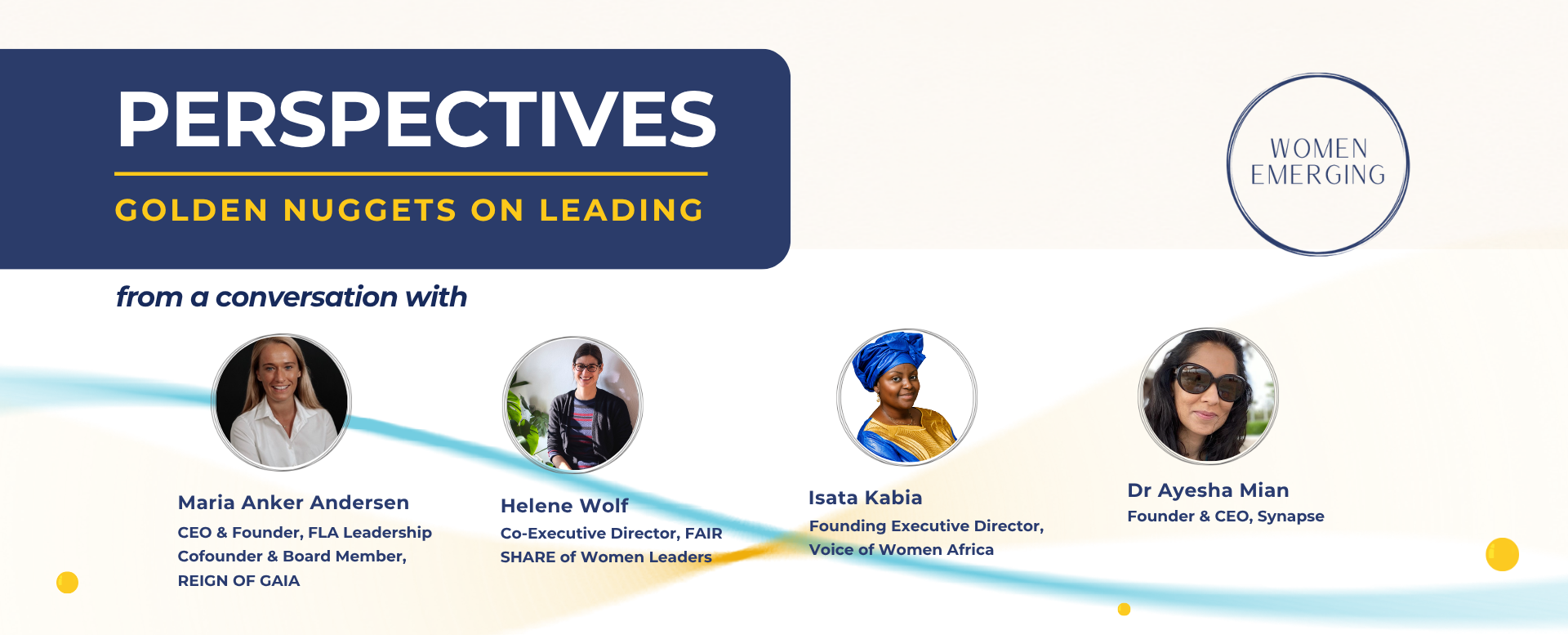
In the Women Emerging podcast episode “Is it Really a Better World for Women Now?”, Ayesha Mian, adult, child & adolescent psychiatrist, in Pakistan questions whether this approach works for women, especially given that the systems certainly were never designed for women. Reflecting on her experience with leadership programmes and dominant ideas around women’s empowerment, she says: “It almost felt like a very aggressive stance.”
And then she adds something that quietly dismantles one of the most influential leadership ideas of the last decade: “You can really only lean in when you have a certain privilege.”
The world keeps telling women that enough has changed. Change might slow for a while but overall progress is good. But the women who are leading are revealing a different story. One where progress cannot only be measured by visibility, titles, or numbers, but by whether women can lead without having to shrink themselves to survive the systems they enter.
The Fairytale of Progress For Women
Again and again, women find themselves reconciling with two completely different realities. The first is the reality the modern world presents to them: women are succeeding, barriers are falling, opportunities are expanding. The second is the reality they continue to experience inside boardrooms, political systems, workplaces, families and leadership spaces that are not intentionally designed for them. So, it looks like a fairytale of progress is overshadowing a harsh reality that women face every day.
Maria Anker Andersen who at a very young age has served various roles as a CEO, founder, board member, adviser captures the reality immediately. Denmark is often spoken about as proof that gender equality works. It consistently ranks high on global equality indexes and is presented internationally as a model of progressive culture. Yet Maria points to a statistic that completely disrupts that image:
“To me, all these myths about women in the Danish society is something I cannot relate to. When we look into the labour market again, we can also see in the 50 largest corporations, only three CEO positions are occupied by women.” – Maria Anker Anderse, Episode 4 – Is it Really a Better World for Women Now?
Only 3. That number exposes the gap between reputation and reality. The question is not whether progress exists, the question is whether the world has started congratulating itself far too early.
Another guest, Helene Wolf, who leads FAIR SHARE of Women Leaders as the Co-Executive Director in Berlin, describes a subtle form of exclusion that many women might immediately recognise where they experience being included in the room without truly feeling included in the discussion.
“I would leave the room feeling not like I belonged in this room, and like, at the same time, that we didn’t have the discussion that we should have had in this room. The worst part is that we become angry at some point, and that we become disempowered, and that we feel we don’t have the capacity to shape discussions and events ourselves, because we never experience it. And we also never get credit or appreciation for everything that we stood for in these meetings.” — Helene Wolf, Episode 4 – Is it Really a Better World for Women Now?
The Emotional Cost of Power
Isata Kabia, another guest on the podcast, speaks about what happens when women move visibly into positions of authority. Her reflections move beyond workplace inequality and into something more personal: the emotional cost of public power. Isata Kabia is the founding executive director of Voice of Women Africa and a former minister in Sierra Leone, advocating for women’s leadership and representation. An excerpt from the interview reads:
Julia Middleton:
What women politicians face daily is almost the crudest form of abuse that women leaders face…I suppose my first question is a sort of big one. Why is it so hard? Why is leadership so hard when you hold political office?
Isata Kabia:
Well, I think there are many reasons why it’s so hard, regardless of the gender, but particularly for women. Women in general are most likely to need money, especially in my neck of the woods. So they may not be financially strong to do it by themselves. So making a decision like that, literally it takes a village and the head of the village will be the husband or the partner or some benefactor that’s a family member. So getting that money is also about getting that permission. So in the first place, women are more likely to need permission from partners or husbands or some family member.
And once you’re able to do that, it’s like you’re kind of beholden to that person. So a husband, when the wife comes late from a political meeting, can now decide, oh, this politics is getting in the way and you can no longer participate and that permission can be withdrawn in a second. Or you get into office and you’re literally always judged by not what you do in your job, but by how much your family is suffering from it. And in addition to that, just because the space we occupy is about really effecting great change, those who are about maintaining the status quo are going to be after you morning, noon and night.
The moment you challenge and decide that you’re going to run for office, it’s about challenging power. And once you decide to do that, there’s always somebody who’s going to be against you because to them, it signifies a loss. When we get into the space of political power, the gendered insults are tailored. They’re ready-made. They’re waiting for a woman who raises up her hand or raises up her head. So even on the campaign trail, the violence is tailored against us. The words, the insults are tailored against us. The people are tailored against us because they’re not used to female leadership.”
Julia Middleton:
Do you ever get immune to the gendered insults?
Isata Kabia:
You’d never get immune to them. The strongest women go home and cry. I’m one of those. There’s a public strength that you have to display because otherwise they say, ‘Oh, look at these women. They say they want this and then they can’t handle it.’ So in effect, it’s like we almost kind of pretend as if we don’t feel, pretend as if we don’t hurt so that we can play with the big boys. But they hurt you the same way as everybody else. And what keeps me going is about keeping my mind and my focus on the bigger picture. I always talk about my why. I know why I’m here.
Julia Middleton:
When you get people who say, ‘Well, why do we need women in politics?’ … what’s the dead end argument you want to avoid?
Isata Kabia:
For me, the dead end argument really is about numbers. This is not about numbers. This is not about us asking for favours. Affirmative action is about correcting a wrong, a wrong that has persisted for so many years that it has now become a culture. We’re not asking for favours, we’re asking for work. We want to work. There’s a lot of work to be done. Not one person can do it, not one gender could work, because the perspective that women bring to the table is otherwise missing.
Julia Middleton:
Do you unintentionally start to almost mimic how male politicians lead because the system is designed for male politicians?
Isata Kabia:
No. My idea of leadership is not to bring more men to the table. My idea of leadership for women is about bringing the difference to the table. And there is a stark difference, a valuable difference. So, my job is not to get to the table and become another man. It’s not what I’m there for. I am a woman leader in all its forms when I’m at the table. I’m a mother. I am a nurturer. I’m a carer because when you are empathetic and you’re a listener, you learn more and then you can give more when you’re at the decision-making table. But generally speaking, when we’re talking about male leadership, it’s about, ‘I’m in charge and I know it all and I’m not listening to unheard voices.’ And that is not what we need more of.
It’s certain that beneath all the language of progress, diversity, and empowerment, the women in these conversations continue describing something far more familiar: exhaustion, adaptation, resistance, and the constant pressure to prove they belong in spaces they have already entered.
And that is the real reason women do not want to celebrate progress just yet because story the world keeps telling women does not feel believable.
About the Author
Kavya Misra is a writer and producer with a background in theatre, films and digital content. Her master’s in English literature forms the foundation for all her creative and corporate projects. In addition to this, Kavya has an extensive background in theatre. She has written and produced plays. She has also performed at festivals like Bharat Rang Mahotsav by National School of Drama, India and International Theatre Festival of Kerala, India.