Last month I wrote about Essence — the irreducible thing underneath the biography. The Women Emerging expedition started there: not with what you have done or what you believe, but with what makes you lead the way you do.
This month the expedition moved outward, to the second circle: Elements. If Essence is what you are, Elements are how it shows up in your leading. The work, as Julia Middleton frames it, is not just to identify them. It is to decide which ones to carry forward, which to set down, and which to turn around and look at differently.
Some things that keep you upright for decades are worth examining.
On 6 October 2023, my therapist referred to me as the Rock of Gibraltar. I left the session and texted my youngest sister Irina a picture of the rock: “My therapist described me as Rock of Gibraltar. I had to look it up.”
She sent back a single heart emoji on the image of the rock. She did not need to say more. We both knew what it meant.
The map
The Elements framework asks you to draw a map: which Elements flow from your Essence, and what do you do with each? Some to jettison — set down without ceremony. Some to reframe — strengths that have been mislabelled as weaknesses. Some to keep, because they are genuinely yours and genuinely useful. As I drew my map, ended up adding notice — not fix and forget, but hold with ongoing awareness, slowing down when they stop helping.
My map looks like this. Drawing it, was in itself, an act of leading.
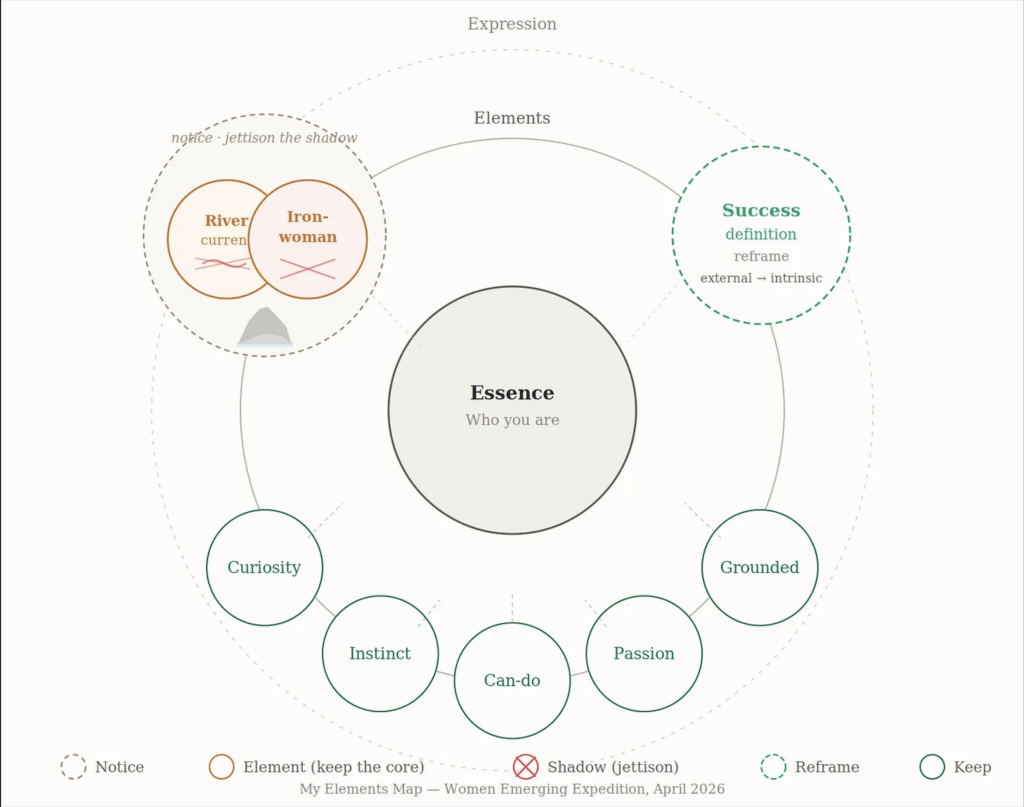
To notice — and jettison the shadow: the river current and the Ironwoman, two expressions of the same formation. To reframe: what success looks like. To keep: curiosity, instinct, can-do, passion, groundedness.
How the formation was built
My parents’ expectations were explicit and, growing up, non-negotiable. Be a stellar student. Be STRONG — the world will crush you if you are not. Be resourceful. Work hard. Be a flawless role model to your four siblings and help them succeed. Be respected. Be someone in society. And when the time comes: marry, have a family, be caring and kind and helpful to those around you.
There is nothing cynical in that list. It came from people who loved me and had shaped these expectations from a context that had not been kind. But what it built, over time, was a particular kind of formation: a person for whom holding together was not a strategy but an identity. The eldest of five. The one who shows up strong.
Later, different environments added their own layers. Transitioning cultures — from Albania to the US to the UK to twenty years of global corporate life — each one requiring a version of me that was composed, capable, already across the room before anyone else had found the door. Fake it till you make it was not a motivational phrase. It was a survival method. The intellectual challenge thrilled me; the performance cost something I did not fully register at the time.
By the time my therapist named it, the Rock of Gibraltar (or Iron Woman) had been under construction for four decades.
Two expressions, one root
In the first dispatch I wrote about the Drini i Zi — the river in the North of Albania that runs fast, does not stop for obstacles, keeps moving. It is part of my Essence and I would not change it.
The river at its best: fast learning, adaptability, energy for the new, the can-do that has opened rooms I was not supposed to be in. The river as shadow: moving so quickly that you miss what the people around you are still processing. I can see this now looking back across personal and professional moments. A family member who showed insecurity in a passing moment — I moved on before she felt met. A team navigating a change in direction — I had already arrived at the new place while some were still mourning what was lost, and I gave too little time to that mourning.
The Ironwoman is a related expression. At its best: resilience, steadiness, the strength that others have leaned on. The Ironwoman as shadow: armour. Opacity. The performance of certainty that quietly makes people smaller, more distant.
The 360-degree review during my Managing Director promotion made the shadow visible in a way I could not ignore. My teams respected my vision, my adaptability, my confidence. They also shared something harder to hear: they sometimes felt nervous they might disappoint me, or appear incompetent. What felt natural to me — staying calm in chaos, moving fast, projecting certainty — was, in their experience, creating distance. My strength, unmoderated, was closing the room.
And the cost was not just professional. A few years ago, someone close to me was going through a difficult time. I was there. But I was focused on holding things together rather than on what was actually needed — which was empathy: the willingness to sit with difficulty without managing it away. That gap was why I eventually sought therapy.
Another cost I understood only later. All my life, being the rock had not just been mine to carry. My family, my friends, my teams had leaned on it too. When I shared a difficulty with my sisters, I could see the discomfort in their faces. Not indifference. Something closer to alarm. Me admitting to a problem was shaking something they had quietly depended on. The rock was not just my identity. It was part of their landscape too.
Neither of these is something to put down entirely. The river and the resilience are part of me and what I bring. What needs watching — and in its shadow expression, setting down — is the speed that outruns the room, and the armour that keeps people at a distance when what they need is presence. Genuine leading, I am learning, is less about what you project and more about what you make possible for others.
The jettisoning did not start with this expedition. It has been a slow process since I started to notice— in how I lead, in personal relationships, in this Substack, which is in its own way an act of putting the rock down and letting people see what is underneath.
This is not something to fix once and file away. It is something to notice — to ask, when the current is moving fast: who is still in the water behind me, and do they know I can see them? That question, I think, is close to the heart of what leading actually requires—and perhaps nowhere more than in philanthropic work, where the people you’re helping are often the least able to tell you they’ve been left behind.
What others are carrying
Two voices from the Women Emerging podcast conversations that shaped my reflection this month stayed with me.
Anna, a Director of Production from Poland, named the good girl element — the implicit instruction about what other people need you to be, sometimes in words, sometimes in a look from her mother. They accumulate quietly. They make leading harder because you are always translating your instincts through someone else’s expectations first. With experience and growing confidence, she said, you start to confront them. You put the load down.
Katrina, a Paralympic gold medallist, described being born with a disability in a world that wanted to fix her — and going to the opposite extreme, becoming the supergirl who needed nothing. She was tired, she said, of endlessly seeking the right amount of enough. She decided she was done with all of it.
Different shapes. The same architecture: an identity built around what you can withstand, rather than what you actually are.
Aleksandra, a pianist on this expedition, brought something quieter. She had been making music through a difficult season — wars, uncertainty, the world pressing against the edges of the work. What she found, after years of depending on external response, was that joy cannot only be drawn from outside. “To radiate our own light outwards,” she said. “Not to take from the world and wait for the world to give me.” I am still thinking about that.
The reframe: what success looks like
A reflection call with Susan, one of our expedition guides helped me name the reframe.
Susan is a lawyer, a philanthropist, a woman in her seventies who has spent decades in public service in the US. She shared a recent significant personal shift. For most of her life, she said, she had been reflexive — responding to what each situation required, driven by obligation and duty. In the last year or two, she had moved toward something more self-reflective: asking not just what needs to be done, but what truly animates me. What actually moves me, rather than what I think I should care about.
For her, it took the body forcing a stop — an illness that made the usual pace impossible, and in that enforced stillness, the discovery that she did not miss most of what she had been doing. For someone who had spent decades directing resources and energy toward public good, that was not a small admission. Obligation can look identical to purpose from the outside. The difference is felt only from within.
I recognised the mechanism, if not the trigger. For me it was not the body. It was the career transition — the moment I started questioning what I wanted to use my passion and skills for. Susan’s question — what truly animates you, rather than what you feel you should care about — helped me name the element that I’m reframing.
The parental expectation to be someone had meant that I used to see success as something visible. Something the community could see. Something that confirmed I had not been crushed.
Later contexts layered their own versions over that foundation. The American definition: ambition and scale. The British one: understated achievement and institutional standing. The Deloitte one: title, scope, the size of what you led. None of these were false. But they were largely external as they depended on the definition and confirmation of the system.
The career transition stripped that away, quite suddenly, and the work since has been to find a different measure. What I am drawn to now: education and youth work readiness, which is consequential in a way that is slower, less visible, closer to what I actually care about. Writing — an attempt to contribute to a conversation about skills and learning and young people that is less transactional and more durable. These will not produce the same markers. They are not supposed to.
Aleksandra’s phrase keeps returning: to radiate your own light outwards, rather than waiting for the world to give it to you. I wrote in an earlier post about getting reacquainted with the version of me that existed before the parental instructions, the cultural layers, the institutional formation. I have been finding my way back to her — through this transition, through this expedition, through the act of writing it down. The map is one way of tracing where she went. And where she might be heading…
About the Author
Anila DeHart is an Advisor, Researcher, and Executive Educator on education-workforce coordination and future-of-work. She examines coordination mechanisms that enable sustainable education-workforce partnerships and equitable pathways from learning to meaningful work. Current collaborations include Higher Education Policy Institute (HEPI) on university-employer partnership infrastructure and the University of Oxford’s AI in Education (AIEOU) 2026 Shared Research Agenda on Future of Education, Work and Institutions.
With twenty years at Deloitte, most recently as Global Managing Director leading talent strategy and workforce transformations for 500,000+ professionals globally, Anila brings deep expertise in future-ready skills systems and organisational change at scale. Her career began in higher education, teaching at universities in Central Europe and as a Fulbright scholar in US, and leading organisational development and strategic recruitment at the University of Arizona.
Anila serves as Executive Coach and Leadership Facilitator at Headspring Executive (Financial Times-IE Business School joint venture). She regularly briefs industry forums on transformation and skills development, and advocates for societal equity through initiatives supporting career advancement for youth and underprivileged groups.