Inclusion sounds simple. In practice, it is anything but.
We often talk about inclusion as though the answer is straightforward: open the door, bring more people into the room and make sure nobody is left out. But what if the room itself was built around assumptions that exclude people? What if inclusion means more than allowing people into an existing system, and instead requires us to question who designed the system, what it values and whether there might be other ways of seeing the world?
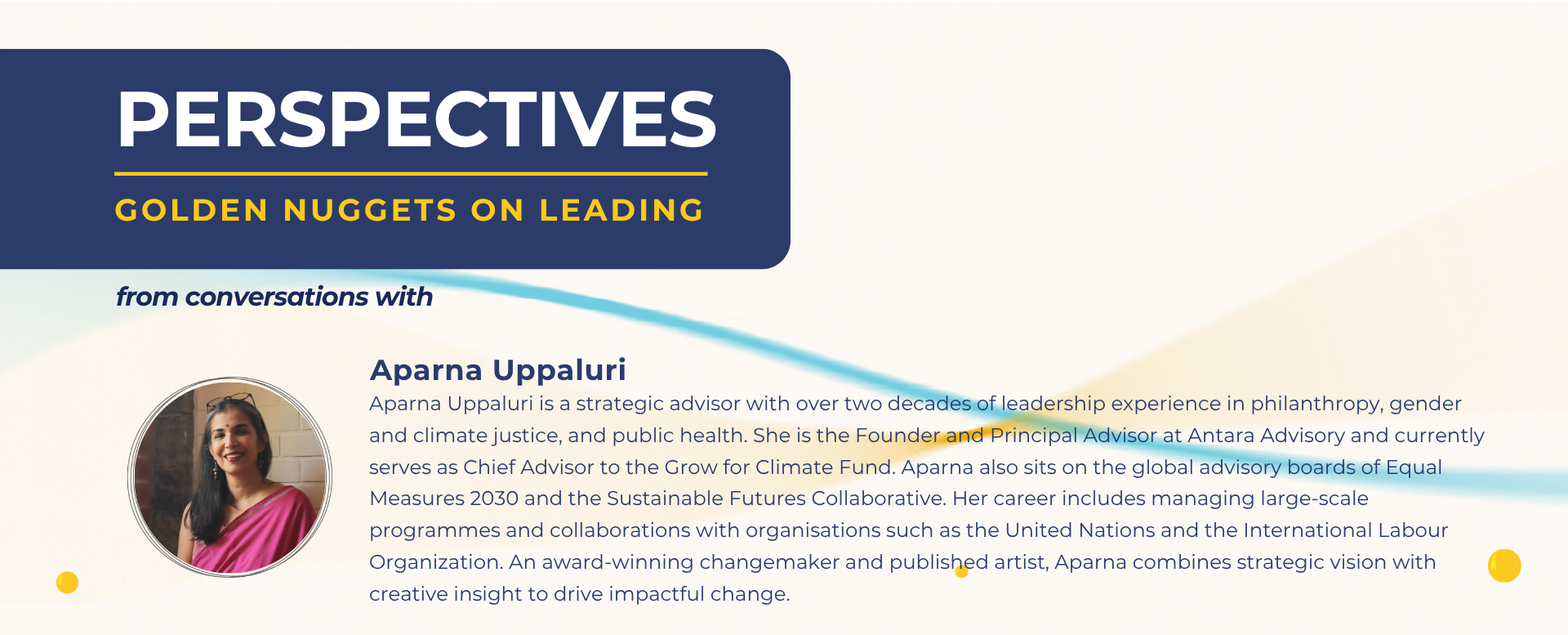
That is where Julia Middleton’s conversation with Aparna Uppaluri begins. Against the backdrop of International Women’s Day and its theme of Inspiring Inclusion, Julia and Aparna explore why inclusion is a “nuanced and flawed and incredibly contextualized” idea. They talk about race, power, gender, history and belonging, but ultimately arrive at a more difficult question: what does it really mean to include someone if we are not prepared to let their presence change the room?
Inclusion Is More Than Bringing People Into the Room
Aparna begins by questioning why we still need to inspire people to be inclusive in 2024. The answer, she suggests, is uncomfortable but obvious. We continue to live in a deeply unequal world in which women have less access to resources, less power, less decision-making authority and less agency.
For that reason, she sees Inspiring Inclusion as both overdue and necessary. But Julia is quick to introduce a complication. If women have spent centuries being excluded, could there be a danger that, once women begin to gain access to positions of power, they simply reproduce the same patterns of exclusion?
“And I suppose also, having been not included for hundreds, if not thousands of years, the danger is that we become excluding ourselves now that we begin to be included.”
It is a deceptively important question. Being included in a system is not necessarily the same as changing that system.
Aparna connects this to one of the conversations that emerged during the Women Emerging Expedition. The women were not simply asking how more women could enter existing forms of leadership. They were questioning the idea of leadership itself. What if leadership did not have to remain a fixed, monolithic concept into which women were simply inserted? What if the concept itself could become more flexible?
She describes this as a “radically different idea of inclusion”: not bringing women into a predetermined model, but allowing their presence to challenge and reshape the model itself.
That distinction sits at the heart of the conversation. Inclusion is not simply about who gets into the room. It is also about whether the room is willing to change.
The World Does Not Look the Same From Every Place
The conversation becomes more difficult when Julia and Aparna revisit an experience from the first Women Emerging Expedition.
The group had been asked to respond to a provocative proposition about whether race should be central to the way leadership was understood. The women physically divided themselves across the room. Some agreed. Some disagreed. Others were caught somewhere in between.
What happened next was not an intellectual debate in which one side persuaded the other. It became emotional. People cried. The disagreement touched something deeper than argument because the women were speaking from very different lived experiences.
Aparna describes the reaction as “visceral”. People were not simply disagreeing about an idea. They felt that their histories, identities and ethical positions were being questioned.
That experience taught her something important about inclusion in a global context. Even a word as seemingly straightforward as race can mean very different things depending on where someone comes from and what history they carry.
For Aparna, growing up as a South Asian Indian immigrant in Canada had given her one understanding of race. Visiting Mexico and confronting the realities of settler colonialism gave her another.
“If we are to be inclusive leaders in the global context, we have to recognize the experience of race, not just as sort of our descent or race as culture, but also race as history.”
That is a profound challenge to the idea that inclusion can be achieved through a universal checklist. The same category may carry different histories, meanings and consequences in different parts of the world.
And when we assume that our own interpretation is universal, we can unintentionally make other people’s experiences invisible.
Aparna puts it starkly: unless we are prepared to “stare something as obvious as race as a form of exclusion in its face”, and challenge the assumptions we hold about it, other forms of exclusion can disappear from view as well.
Inclusion therefore requires something more demanding than awareness.
It requires humility.
It asks us to recognise that our understanding of the world is partial—and that other people’s experiences may reveal things we cannot see from where we stand.
To Be Truly Inclusive, You Have to Be Brave
It is Julia who draws the next conclusion.
After hearing Aparna describe the emotional intensity of the Expedition discussion, she observes:
“Maybe Aparna, it reveals and it reminds us that to be really inclusive, you have to be unbelievably brave.”
Aparna’s response is immediate:
“Justice takes courage.”
That exchange captures something that is easy to lose when inclusion becomes a corporate initiative or a set of organisational practices. Inclusion can sound comfortable. Justice rarely is.
To genuinely include someone whose worldview is different from ours requires us to risk being challenged. It may require us to question assumptions we have held for years. It may even require us to give up something—power, certainty, control or the belief that our version of progress is the right one.
Aparna challenges another familiar argument here. We are often told that greater equality is good because it improves economies. We hear that bringing more women into the workforce will increase GDP. That inequality is economically inefficient.
But she asks a much more fundamental question:
“Do you fight for a just world because a just world is important? Or do you fight for a just world because your GDP will go up?”
The distinction matters.
If inclusion is justified only because it produces better economic outcomes, then people are being included because they are useful to the existing system. Their value is still being measured against the system’s definition of progress.
Aparna asks us to consider something more radical: what if inclusion is intrinsically good?
What if people deserve equal opportunity regardless of whether their inclusion makes the economy grow?
And what if that means questioning the very idea of progress that we are trying to accelerate?
Who Gets to Decide What Progress Looks Like?
This is where Aparna pushes the concept of inclusion to its limits.
We often speak about “bringing people into the room”. It sounds generous. But Aparna asks who designed the room in the first place.
“Who is it that gets to define and say that we need to be inclusive?”
If the people with the greatest power define what progress looks like, then inclusion can become an invitation for everyone else to enter that existing framework and adopt its assumptions.
More people are in the room.
But the room hasn’t changed.
Aparna describes an alternative:
“Maybe my idea of what the world should look like is not the idea, or our ideas are not the only ideas, and we then break the walls down rather than just get more people into the room.”
That is perhaps the most challenging idea in the entire conversation.
Breaking the walls down is much harder than opening the door.
Opening the door leaves the structure intact. Breaking the walls down means questioning the boundaries themselves.
It means asking whose definition of a good life matters. Whose idea of success matters. Whose version of progress matters. Whose knowledge is treated as expertise. And who gets to decide what people are being included into.
Aparna even questions the language of belonging. We now talk about diversity, equity, inclusion and belonging, but she asks:
“Belonging to whom? Belonging to what?”
It is a deceptively simple question.
Someone may have a profound sense of belonging in a community where they have little power. Moving into a position where they have greater power may give them less of that sense of belonging.
Does that mean they should stay where they are?
Of course not.
The point is that inclusion cannot be reduced to making everyone feel comfortable inside one particular structure. It must also protect people’s aspirations, worldviews and definitions of what a good life can be.
The Danger of Making Inclusion a Checklist
The conversation then moves from the philosophical to the deeply practical.
Julia describes a pattern she has observed in people who genuinely want to be inclusive. They may work extremely hard to include the people they see most clearly, or the people whose experiences matter most to them.
But then another problem appears.
“Race matters more than faith, faith matters more than disability, disability matters more…”
Inclusion can become a competition between different forms of exclusion.
One group is placed at the top of the hierarchy. Another is pushed further down. And suddenly the attempt to be inclusive has created another form of exclusion.
Aparna’s own experience of building a team illustrates how difficult this can be.
She works in an organisation where she is the first woman to hold a leadership position. On the surface, that sounds like a straightforward step towards inclusion. But she questions whether it really is if the organisation is unwilling to accommodate what a woman might bring differently.
“Inclusion has to be more than just having a woman in leadership.”
It must include a willingness to accommodate a different perspective on how work is done, how decisions are made and how leading itself is understood.
That distinction between token inclusion and genuine inclusion is crucial.
Having someone present is not the same as making space for what they bring.
Sometimes Inclusion Means Getting Out of the Way
Aparna also talks about her own responsibility to younger women.
She feels deeply committed to opening doors for them, helping them navigate organisations that can still be male-dominated, and creating opportunities for them to grow.
But she describes one part of that responsibility in a particularly striking way:
“How can I sometimes get out of the way so that they can occupy more room for themselves?”
That is a different model of power.
Opening doors still leaves the person holding the door in control.
Getting out of the way changes the distribution of space itself.
But Aparna’s experience building a strategic team pushed her thinking even further.
Rather than beginning with a checklist—how many women, how many people from particular backgrounds—she asked a different question:
Whose voices actually need to be in this room to think about the problems we are trying to solve?
The work focused on issues such as malnutrition, poverty and other forms of exclusion and deprivation. So she deliberately looked for people whose lived experiences could change how the team understood those problems.
The resulting team included first-generation learners and people from excluded caste and faith communities. But she did not recruit as many women as she might have if she had started with gender representation as the primary measure.
That was a difficult decision.
It meant accepting that inclusion was not always going to produce the neat demographic balance she might have expected.
And then something happened that challenged Aparna even further.
One of the men on the team acknowledged that the lack of women was a problem—but then pointed out that having a woman leading the team gave the men an opportunity to learn from her.
He wanted to learn how to lead differently.
And he hoped that the next four people they hired would be women.
Aparna hadn’t expected that response.
It made her realise that inclusion was happening in both directions.
The person leading was not simply including the team.
The team was also willing to examine its own assumptions about who gets to lead and what leading should look like.
Inclusion Changes the Person Doing the Including
Julia identifies what has happened.
“Inclusive was not just putting that team together. It was accepting that there were people in the team who were thinking things that were very unfamiliar to you that you didn’t really understand. That you were jumping into the deep end yourself.”
That may be the most useful definition of inclusion to emerge from the conversation.
It isn’t simply something we do to other people.
It changes us.
Aparna admits that the people she brought into the team had lived experiences she had never had. Those experiences would affect the way they interpreted data, analysed information and measured progress.
And that meant Aparna herself had to make space for perspectives that might otherwise have been overlooked.
“It’s those lived experiences which would then inform the way that we would look at data and analyze content and measure our progress.”
This is where inclusion becomes more than representation.
Representation changes who is present.
Inclusion changes what becomes possible because they are present.
And that distinction matters enormously.
A team can be diverse on paper while remaining intellectually homogeneous. It can contain people from different backgrounds who are still expected to think, behave and define success in exactly the same way.
True inclusion asks more.
It asks whether we are willing to be changed by what other people know.
Inclusion Is Complicated. That Is Not a Reason to Retreat
By the end of the conversation, Julia admits that she has changed her own understanding of the word.
She began by calling inclusion “nuanced and flawed and incredibly contextualized.”
By the end, she describes it as:
“A tricky and complex and beautiful word.”
That complexity can be intimidating.
There is a danger, Julia says, that we become so aware of how difficult inclusion is that we retreat from it altogether.
But that would miss the point.
The answer to a complicated concept is not to abandon it. It is to become more thoughtful about how we practise it.
And Julia returns to the phrase that began the conversation: Inspiring Inclusion.
She connects it particularly to something she cares deeply about: inclusion across generations.
Because exclusion does not only happen across race, gender, faith, disability or class. It can happen between generations too. Older generations can talk down to younger ones. Younger generations can dismiss older ones.
“Generational inclusivity seems to me to be absolutely crucial, always has been, but is even more in this complex and messy world.”
Perhaps that is where this conversation ultimately lands.
Inclusion isn’t a destination where we can eventually declare ourselves inclusive.
It is a continuing willingness to question who is missing, whose experience is invisible, whose assumptions dominate, and what we might have to give up in order to make room for another way of seeing.
It asks us not only to open doors, but sometimes to remove them.
Not only to invite people into the room, but to let them change what happens inside it.
Not only to include different people, but to allow different ideas of progress, power and possibility to coexist.
And perhaps most challenging of all, it asks us to recognise that we may be the ones who need to change.
Because inclusion becomes meaningful only when the people who enter the room are allowed to change the room.
Excerpt from the Episode
Julia Middleton: This week is Women’s Day week, and the hashtag this year is Inspiring Inclusion. A beautiful concept, an important concept in a divided and a fragmented and a polarized world. And so important that it is the hashtag. But at the same time, it feels like we just have to call out and shout out that it is not as simple a concept as people seem to think it is sometimes. Inclusion is nuanced and flawed and incredibly contextualized.
Aparna Uppaluri: I think inspiring inclusion is important because, as you said, we continue to inhabit a deeply unequal world, especially divided for many reasons, but particularly divided along the axis of gender. I think we live in a world where women continue to have fewer rights, fewer access to resources, lesser access to resources, less power, less decision making, less agency.
Julia Middleton: And if we as women bring something to leading, it must be inclusion. And I suppose also, having been not included for hundreds, if not thousands of years, the danger is that we become excluding ourselves now that we begin to be included.
Aparna Uppaluri: Sometimes I wonder about this idea that leadership has to be inclusive, because we’ve debated about this so much in our expedition groups. Are we talking about an inclusive leadership when we talk about women leading, that there’s going to be more women in leadership, and we’re not challenging the idea of leadership itself?
And then we all sat back and said, no, we’re talking about a different form of leadership, form of leadership that resonates with women.
And I think that’s where the beautiful nuance of inclusion comes up, which is not leadership as this monolithic idea into which women get included, but leadership as a flexible, fungible idea, where you can actually play with the idea of what leadership is and have women think about a new form of leadership that resonates with them.
That’s a radically different idea of inclusion.
Julia Middleton: One of the tensions on the First Expedition was almost getting Western women like me to shut up and to recognize that how we see the world is not the only way the world can be seen. That was an important message, wasn’t it, Aparna?
Aparna Uppaluri: I think so, Julia. I think it was important to show each other both our wounds and our ignorance.
In February of last year, when the first team of the Expedition members met at the Rockefeller Center in Villages, and we had a five-day deep dive into everything that we could talk about to really unpack how we lead, one day we had a very challenging conversation and a heated debate about, around a provocative statement, I think these were statements that were designed to provoke, which said that race was central to leadership, or a consideration of race, that race had to be put at the center of how we thought about and defined leadership.
And we had a rather divided group. There were many who stood in the middle of the room because they couldn’t make up their mind. There were a few that went to one end of the room that said, no, we don’t think it should be central. And there were about three or four of us that went to the side of the room that said, yes, it has to be central.
And I think the feeling that a lot of us were left with was that we were not able to communicate to each other where we were coming from, because it was very, it was a very visceral feeling. It wasn’t so much dominated by logic or argument, but it was a visceral feeling of I agree or I disagree.
And I think that was the first time that we actually had tears, because we almost felt like we were questioning each other’s commitments, each other’s ethical positions in the world. And I think it’s very relevant to this conversation around inclusion.
Julia Middleton: Maybe Aparna, it reveals and it reminds us that to be really inclusive, you have to be unbelievably brave.
Aparna Uppaluri: Justice takes courage. And I think maybe that’s why inspiring inclusion, because we need to be inspired, so that we can be courageous.
Aparna Uppaluri: Do you fight for a just world because a just world is important? Or do you fight for a just world because your GDP will go up?
We often hear this, that inequality actually is not good for growing economies. It’s not because inequality is bad in itself, right? It’s that it’s an unjust structure of the world in itself.
We hear this in India all the time, that we need to include more women in the workforce because our GDP will go up by X percent if more women were working. Not because women must have equal opportunity. Whether the GDP goes up or not shouldn’t matter.
So is there intrinsic good? Is inclusion an intrinsic good? Or is inclusion something that we should push for because it’s going to give us progress?
Aparna Uppaluri: Pushing at the limits of what we mean by inclusion will help us become more inclusive.
Julia Middleton: That’s a really interesting sentence. Pushing at the limits. Go on, explain what you mean.
Aparna Uppaluri: Who is it that gets to define and say that we need to be inclusive? Let’s inspire inclusion. Who says that? Someone who has more power over a particular world view.
Therefore, we say, let’s get more people into the room.
Now, instead, if I were to say, hey, maybe my idea of what the world should look like is not the idea, or our ideas are not the only ideas, and we then break the walls down rather than just get more people into the room.
Because this idea of inspiring inclusion to me sometimes feels like, the idea of inclusion sometimes feels like there’s a fixed boundary into which people must, because now there’s DEI and B, diversity, equity, inclusion and belonging.
Belonging to whom? To what?
Julia Middleton: Really good people who do everything they possibly can to be inclusive, but often only to the people that they see, who are visible to them, or that they see the most, or that they care about the most.
And working with them is almost, you feel like they’re putting their own element of inclusive to the top of the pile. You know, race matters more than faith, faith matters more than disability, disability matters more, you know, which one… It’s almost a sort of fight for the hierarchy, which encourages a blind verse towards inclusivity.
Aparna Uppaluri: I now work in an organization where I’m the first woman leader. They’ve never had a woman in leadership before. Now, you could ask me whether that was a step towards inclusion. And I’m not quite sure that it has been because inclusion has to be more than just having a woman in leadership.
It also has to be a willingness to accommodate that a woman in leadership can bring a very different, not just style of leadership, but a very different perspective on how to lead.
And so I think as women, we’ve all been in rooms where we’ve been the token woman. And being the token woman is different than being a woman who is pioneering.
Julia Middleton: And if we go back over what you’ve said, I suppose inclusive was not just putting that team together. It was accepting that there were people in the team who were thinking things that were very unfamiliar to you that you didn’t really understand. That you were jumping into the deep end yourself.
Aparna Uppaluri: Well, yes, there were lived experiences that I’ve never had. And it’s those lived experiences which would then inform the way that we would look at data and analyze content and measure our progress, and that the perspective that they would bring would be so much more powerful than, let’s say, an upper-caste, privileged woman would like me.
And so, I think that’s really what I needed to push myself to do.
Julia Middleton: Thank you, Aparna, that’s given me so much more to think about. I thought it was a tricky word before. Now I think it’s a tricky and complex and beautiful word, but now, conceive more angles of trickiness, complexity and beauty in it.
There’s a real danger that we almost sort of back off from inclusivity because of the trickiness in the world, the word, the complexity, the sort of onion layers of the word.
But let us not forget, hashtag inspiring inclusion. We absolutely have to drive this, we as women leaders, and we need to be passionate about it.
And particularly passionate about an angle that I care about an enormous amount is inclusivity across generations.
That some generations don’t talk down to other generations, and some generations don’t dismiss upwards to other generations.
Generational inclusivity seems to me to be absolutely crucial, always has been, but is even more in this complex and messy world.