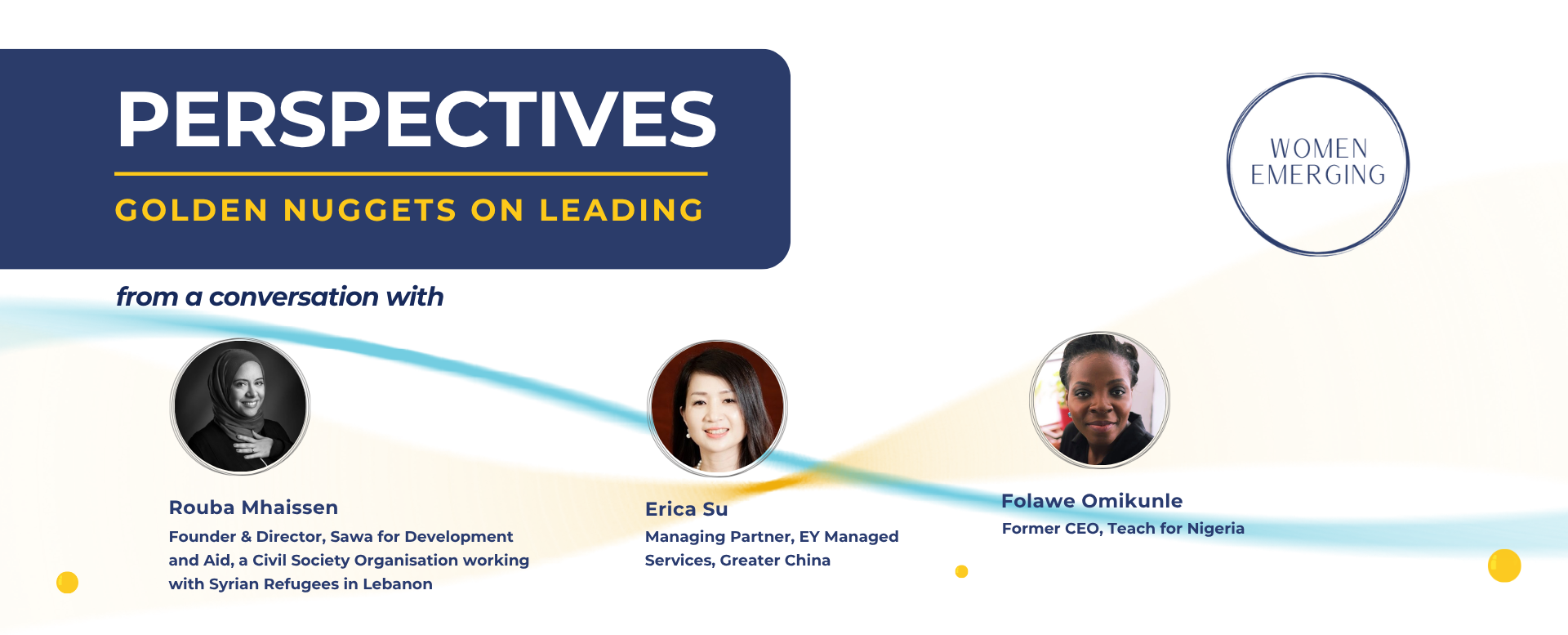
Three women, three different sectors, three different cultures, three different journeys to leadership.
Rouba Mhaissen is the founder & director of Sawa for Development and Aid, working with Syrian refugees in Lebanon. Erica Su is the managing partner at EY Manged Services, in Greater China; and Folawe Omikunle is the former CEO of Teach for Nigeria where she led efforts to address education inequity. So, three different purposes too, then what binds them together? – They do not identify as ‘Leaders’.
If leadership was ever a destination where we arrive, a mountain we conquer, a ladder we climb – I wonder what does that ‘climb’ looks like? And what do some of the big “Aha! Moments” of that journey, look like? You know? Those moments when your eyes pop out, your voice squeals a little and your mind goes – “Aha! I just discovered something”
You can call it something else too, ancient Greek scholar Archimedes called it εὕρηκα (heúrēka), commonly known in Modern English as Eureka!
Whatsoever, I am convinced that a woman’s Aha! Moment is worth reflecting upon because it doesn’t only carry the excitement of “oh I have finally arrived” it also carries the reminiscence of the fact that women do not give themselves enough credit for the work they put out in this world; they keep doing the groundwork; they keep climbing up the ladder; they keep walking forward with a crowd of people marching behind them (though quite often with them) but they never sit and reflect, what they have been doing all this while, is leading.
Rhouba’s Aha Moment: Reinvent Yourself
“I think one of the major turning points of my leadership journey was when I moved outside the region for my studies. This was because it was at that point that the Syrian Revolution had started,” Rhouba recounts. She was 22 when she heard about the first 40 Syrian families who had moved to Lebanon and become refugees, and she knew she will have to something about it. She started Sawa as a small initiative, but it never occurred to her that this was going to be the starting point of my leadership journey.
She recollects her first Aha! Moment, “I remember going back to London to continue my studies, and I was invited to Parliament to speak about Syria. I had never done public speaking before; I had never done anything like that. I was so scared and afraid about going into Parliament as a 22-year-old to talk about politics, human rights, and refugees. It was that leap of faith that I had to take because, at that moment, I realised that a lot of men and women in my country were dying. The least I could do was step up and talk about what they were facing.”
She didn’t think of it as a choice, it was a responsibility for her.
“What also helped me [to gather courage in that moment] was that I was outside my context. I wasn’t in the place where I grew up, where women were expected to act or be a certain way. Since I was outside of that context, I was operating outside of the norms, paradigms, and structures that were designed for any leader or any person in that environment.”
And so, she could be whoever she wanted to be. She could reinvent herself and think about her identity differently.
“I could reflect daily on what I was going through and reinvent who Rhouba was—as a person, as a human being, as a leader, as a public speaker, and as someone trying to do something bigger than herself, Rhouba mentions.”
Rhouba speaks about having the space to reinvent herself. Yet even after building an organisation, she did not recognise herself as a leader until she realised that others were looking up to her and following her lead.
As you listen to Rhouba, you can sense a slight discomfort. I could almost picture her shrugging as she said, “…you can call it imposter syndrome.”
“You could call it something much nicer than that,” Julia immediately interjected. “You could call it humility,” she completed.
That reframing feels necessary. Calling women’s judgement, caution or self-doubt “imposter syndrome” can be painfully reductive. I wonder how often the term has unsettled capable minds and slowed the path to leadership for many women.
Erica’s Aha! Moment: Own Your Self-Defining Story
Erica’s experience raises a similar question, but from a very different context. Her sector, specialism and priorities are very different from Rhouba. Erica explains why it is important to own your self-defining story.
Julia: Erica, why did you use that expression, “It’s my story, nobody else’s. This is my story”?
Erica: Because you’re going to drive your own journey, and not somebody else. Somebody else can help you, but you cannot live in somebody else’s profile or expression about yourself, because you are the one who’s writing this journey, not somebody else.
When people say, “Oh, you have been nominated,” or “You’ve been put up for this position as a big promotion,” you feel honoured, of course. But at the same time, you also feel tremendous pressure to say yes, because otherwise you think, “What if I say no? What message am I sending to the people who support me, to my sponsor?” Am I letting them down? Am I sending a message that I’m not ambitious enough? That I’m not aggressive enough? That I just want an easy life?
Julia: There’s a real danger, I suppose, of people wanting you to do it so much that you just sort of fall into it because you don’t want to disappoint anybody.
Erica: Yeah, definitely. Because you may find yourself either not ready, not happy, or not capable.
Julia: You gave me a fabulous list of the questions you ask yourself when someone suggests a new role to you. Let me go through them if I may. Your first question is: Can I do it? And that is because you think competence comes first?
Erica: Yeah. I think competency comes first, and you also have to have a realistic assessment of your capability and the job requirements. It won’t be a hundred percent match, of course, but it should be reasonably aligned.
Julia: And then your second question is: Do I want the responsibility? What’s behind that one?
Erica: Because I think in most parts of the world, when men and women take the same position, women are often subjected to more scrutiny in terms of how their performance is evaluated compared to their male peers. Sometimes that’s simply because of unconscious or community bias. So, you need to be prepared for that level of scrutiny. And then there’s the responsibility itself. You’reresponsible for making difficult decisions. If you’re not comfortable making really tough decisions, then you have to think about what you’re taking on. You’re responsible for people’s careers, for the success of the business, for accountability, and for the direction of the organization. That’s when you ask yourself, “Do I really want that?” And sometimes you may decide it’s better to step back a little—not step down, but step back—and do something that feels more comfortable or requires less stretching.
Julia: And I suppose that comes to the point of “It’s my story, not yours.” I might want that responsibility, but I might not want it now. And this is my story, not your story.
Erica: Yeah, that’s the case. And sometimes you also need to draw a line. It’s not about refusing to step outside your comfort zone. You absolutely need the courage to step outside your comfort zone and stretch yourself. But how far you want to stretch is a personal judgment. If I feel I have already stretched too much, then even if people tell me, “You should go for that,” I may say, “Wait a second. I want to step back. I don’t want to go for that because the stretch is too much.” Not only for me personally, career-wise or work-wise, but also for my family and the other people who are on that journey with me.
Julia: And I suppose what the outside world sees them as self-limiting and almost goads you into doing what you shouldn’t do, because you don’t want to appear to be self-limiting.
And what you’re saying is no, you’ve got to define yourself.
Erica: Yeah, that is absolutely true. And also, it takes more courage to do self-defining than worry about people thinking you are self-limiting, meaning taking much more courage to say no, if not supposed to say yes.
Julia: The courage to say no and to self-define.
Erica: Yes.
It makes me wonder what else gets folded into the blanket phrase “imposter syndrome”. In Rhouba’s case, there is humility; in Erica’s, there is clarity. I think about how often I have used the term casually, only to feel it chip away at my confidence and make me feel flawed, rather than like someone trying to grow into her work. It takes courage to find your self-defining story.
Folawe’s Aha! Moment: You Cannot Please Everyone
The last guest on this podcast episode is Folawe Omikunle, who is the former CEO of Teach for Nigeria, where she led efforts to address education inequity.
On her social media, she calls herself a problem solver, if you visit her Linkedin profile, you’ll see the following quote by Woodrow Wilson in her “about me” section –
“We are not put into this world to sit and know, we are put in it to act, and act we must.” – Woodrow Wilson, October 25, 1902.
And that is the spirit she carries within her, the intention to act. In her leadership, she leads with love, and her Aha! Moment is deeply rooted in love. But her learning has been that you cannot really become a leader and be loved all the time.
“I came into leadership without thinking that I was going to become a leader. And being an introvert who just always wanted to be by herself and not really have people who would be upset with me or at me, or who wouldn’t quite like me, I always ran away from difficult conversations. I would rather just make sure that everyone was fine and happy. And I think one leadership moment had to be a quote that I saw and it said, ‘if you want to be liked, you can sell ice creams and not be a leader’. And I think that for me in that moment just made me realise that being a leader doesn’t mean that everybody will love you. And being a leader doesn’t mean that everybody will be happy with the decisions that you have to make. But you have to make the decisions in the best interest of the cause that you’re working towards or that you’re fighting for. You cannot take a decision based on the fact that you want people to like you or you want people to not get angry and not get upset with you. And I think for me, it was one of the most game-changing moments of my life, as I went on with my leadership journey.
Rhouba, Erica and Folawe, all three of them, despite their different contexts have a lot in common. Find out what all in this episode that was so good that we decided to re-release it recently. This time you will have to make proper note of Julia’s warning –
“It is a very very rich episode…if you’ve set aside, just over 30 minutes to listen to this episode, I think you better double it. I suspect you will be listening to it again.”