Women Emerging Expedition: Dispatch One — April 2026 (Anila DeHart)
Before we said a word about leadership or philanthropy, we were asked to share a picture. Not a headshot. Not an achievement. A picture of something we love, and where home is.
What came through over the following days — from Botswana, Saudi Arabia, Poland, Lebanon, Vietnam, Nigeria, Portugal, Kenya, Hungary, London, Mumbai and beyond — was not what I expected from a group of accomplished women philanthropists. Almost nobody shared a stage or a platform or a cause. They shared a magnolia tree finally noticed after years of being too busy to look. A 16-month-old being held close. Dogs in a Kenyan landscape. A family gathered in a moment of history, a new grandchild not yet in the photograph. A piano. A vineyard in the Douro. A journal resting on a waiting room chair.
Julia shared a photograph of a grandchild and her husband baking together. One of my many grandchildren with my husband doing something very practical together. My loves. No credentials. No context. Just that. Somewhere in that scrolling sequence of images, before any of us had spoken, the group revealed itself. These were women who had spent decades in boardrooms and foundations and field programmes — and what they reached for, when asked what they loved, was almost always something quiet.
The first call brought together 29 Explorers from across the globe, split across two calls to work with time zones. I came into this first call in an unusual position. I had interviewed most of the Explorers one-to-one and written their stories, which were used as profiles that introduced us to each other. Julia commented in the group chat the morning of our first call, still in bed, and said they were beautiful. One of the Explorers wrote on the chat: “I will work hard to become that woman described there.” This meant that I arrived at the call with a sense of familiarity, belonging and readiness to listen and reflect, rather than a need to prove myself.
Before the call began, the weight of the world was already in the room. Several Explorers named it directly at the start — the war in the Middle East, the political context in the US around DEI and social justice, the sense of leading into headwinds. You could feel the heaviness.
Then the call moved on, as it had to, into the question that brought everyone there: what brought you to philanthropy?
The answers were not clean. For most, there was no single origin story — just a cluster of reasons. Family, injustice, guilt about privilege, the need to give life meaning, the pull of service. Several people struggled with the word philanthropist as a description of themselves. One said she preferred to think of herself as a human rights activist. Another said her giving had begun long before she had a name for it. Partway through the call, one of the women paused — she was observing Ramadan, and this was the moment she could break her fast. She stepped away briefly and rejoined. It was a small thing. But something about it stayed with me: the willingness to be fully present in a conversation about what matters, at a personal cost most of us hadn’t registered. That felt like its own kind of leadership note.
After the call, the real work began.
* * *
The expedition’s approach to Essence is deliberate. Not a single conversation but an accumulation: reading, listening to podcasts, journaling, drawing a map of your own Essence, and then a paired conversation with another Explorer. The idea is that Essence reveals itself slowly, through different angles.
Julia’s book offers seven pieces as a starting point; motherness, nature, the body, the sacred, ancestors, trauma and education. Not a fixed set but an invitation. As she puts it, they are offered “by way of illustration and as an invitation to consider the pieces of your own Essence.” Everyone will have different ones. Some will be the same, done differently.
I drew my map on the 28th of March.
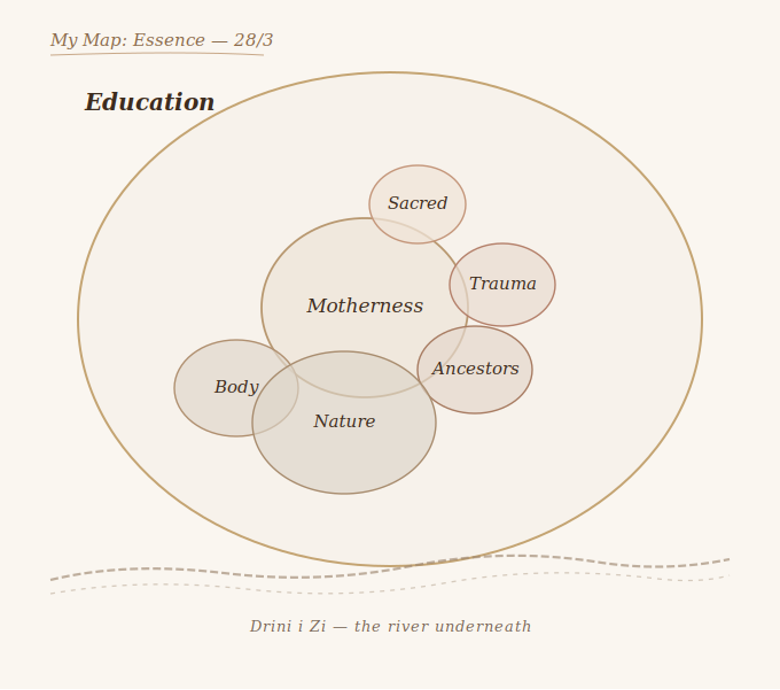
Education came first and ended up containing all the others. That felt right. Learning has always been the thing I reach for first: as food, as oxygen, as the mechanism that opens doors, as a marker of dignity and contribution.
Motherness landed at the centre. I came into responsibility early — eldest of five in a traditional context, the household depending on me to show up as steady and capable. That shaped a reflex toward care that shows up in my own mothering of my two daughters, and in my personal and professional relationships.
What the drawing made visible was how much of my formation came through two women: my mother and my grandmother, Nana.
The sacred, trauma and ancestors all cluster around motherness in the map because they reached me through those two specific people. The beliefs about what women should be, the expectations of strength and endurance, the faith and values held as non-negotiable — these were carried in the way my mother moved through difficulty and in what my grandmother passed down without ever naming it as a lesson. The sacred for me is not religion, but the values I hold most deeply. Trauma is the shadow of those same high expectations.
The body and nature appear together at the bottom, overlapping heavily. I grew up uncomfortable in my body — shaped by the contradiction of needing to be physically strong to survive in a mountainous village and the norms about girls and femininity. That I now feel strong and proud of what my body does rather than how it looks feels like one of the quieter achievements of adult life. Nature is inseparable from that: I grew up next to the mountains and the Drini i Zi (the Black Drin river). Growing up, I ached to escape the harshness of the environment. With age, I find myself drawn back to it. I find stillness and wholeness outdoors.
The surprise was not any single circle, but what appeared outside them. The river was not a category on the map. It appeared afterwards, when I asked myself what the picture said about my approach to leading. The energy of it, the speed, the way it cut new channels when the old ones were blocked, the pride and constancy — both connecting with the past and forming new frontiers. I grew up thinking that was just how things were. That you moved fast and adapted. That imperfection was not a reason to stop. That there was always a new bed to cut if the current one was blocked. The river shaped me before I knew I was being shaped.
But rivers that always find another route can also move past things too quickly. They can erode what deserved more care. They can mistake momentum for direction. The Essence work is the attempt to turn around and see it clearly — not just the energy the river gave me, but what it may have cost. Two questions I am carrying into the months ahead:
Where has moving fast served the people I was leading — and where has it left them behind?
What have I treated as an obstacle to route around, when it deserved to be met directly?
About the Author
Anila DeHart is an Advisor, Researcher, and Executive Educator on education-workforce coordination and future-of-work. She examines coordination mechanisms that enable sustainable education-workforce partnerships and equitable pathways from learning to meaningful work. Current collaborations include Higher Education Policy Institute (HEPI) on university-employer partnership infrastructure and the University of Oxford’s AI in Education (AIEOU) 2026 Shared Research Agenda on Future of Education, Work and Institutions.
With twenty years at Deloitte, most recently as Global Managing Director leading talent strategy and workforce transformations for 500,000+ professionals globally, Anila brings deep expertise in future-ready skills systems and organisational change at scale. Her career began in higher education, teaching at universities in Central Europe and as a Fulbright scholar in US, and leading organisational development and strategic recruitment at the University of Arizona.
Anila serves as Executive Coach and Leadership Facilitator at Headspring Executive (Financial Times-IE Business School joint venture). She regularly briefs industry forums on transformation and skills development, and advocates for societal equity through initiatives supporting career advancement for youth and underprivileged groups.